
You know the script. Real men don't cry. They don't ask for help. They work hard, stay stoic, and provide for their families. Be strong. Be self-reliant. Stay on top.
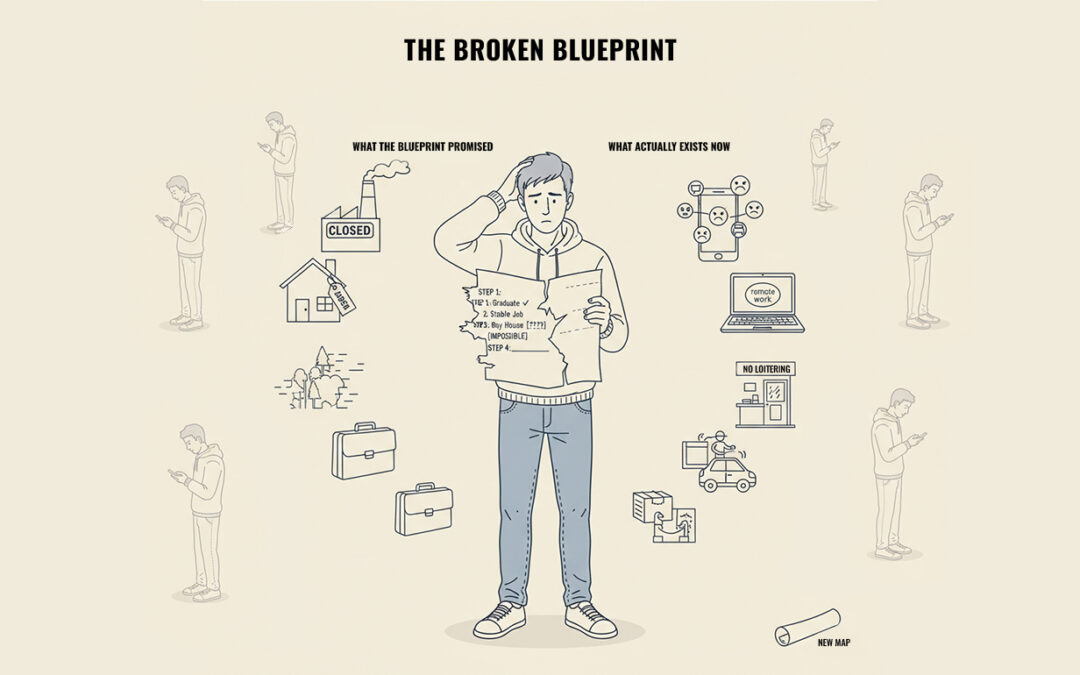
For generations, this came with a deal: follow the rules, get rewarded. Graduate, get a stable job, buy a house, support a family. The emotional shutdown was brutal, but it came with compensations—a defined role, clear expectations, and security.
That deal is broken.
The Economic Ground Has Shifted
Manufacturing jobs that paid middle-class wages without requiring a degree? Gone. In the 1970s, you could graduate high school, get a union job, and support a family on one income. That world has evaporated.
Housing costs have decoupled from wages absurdly. Cities where jobs exist are increasingly unaffordable. Hard work leading to security feels less like a plan and more like a fantasy.
Meanwhile, the script still demands you be the provider, the rock. But the economic foundation that made that achievable has collapsed. You're being judged by standards built for a world that no longer exists.
The Social Infrastructure Has Crumbled
Extended families within blocks. Neighbors you knew by name. Union halls, corner bars—"third places" where men could gather without an agenda. Connection was built into daily life. Proximity did the work.
Now? Those spaces have disappeared. Remote work eliminated daily contact. The gig economy means fewer coworkers. We move constantly—for school, work, cheaper rent—resetting social networks to zero.
The Dominance Model Poisons What's Left
When success means zero-sum competition, everyone becomes a threat. Friends become people to outperform. Asking for help becomes failure.
If you can't show weakness, you can't ask for help when drowning financially. If you can't admit loneliness, you can't reach out for friendships that might save you. Stoic silence now just leaves you isolated, scrolling through highlight reels, convinced everyone else has it figured out.
Social Media Sold You a Lie
Into this vacuum rushed the algorithms. Social media promised connection but delivered engagement metrics. Influencers monetizing your confusion sell alpha male courses and sigma grindset content—not solutions, but products designed to keep you buying a performance of masculinity that feels foreign because it is.
This Isn't Your Fault
If you're struggling to build friendships or feel like you're making progress, that's not evidence you're broken. It's evidence you're doing something genuinely difficult in an environment designed to make it harder.
The wrong diagnosis—"I'm not alpha enough"—leads to wasted energy on self-optimization. You buy courses. You perform. You compare yourself to curated perfection. That keeps you stuck and isolated, framing struggle as individual failure rather than a collective problem.
A Different Build
The alternative isn't returning to an imagined past. It's seeing clearly: the traditional script is collapsing, and men following it pay the price. Economic promises won't materialize. Emotional shutdown creates isolation. The dominance model destroys relationships you need.
Understanding this changes everything. You can stop wasting energy on shame. The difficulty is real, not entirely your fault, and not insurmountable. You can build something different—not by performing someone else's masculinity, but by figuring out what works now.
That means learning emotional literacy. Building intentional friendships. Redefining success as building with others, not dominating them. Asking for help. Showing up even when it's awkward.
It means being built different.
You're not helpless. You're just working with an outdated map. It's time to draw a new one.
What part of the traditional masculine script do you find hardest to let go of? Drop a comment below.
Want to go deeper? "Built Different: A Young Man's Guide to Becoming Who You Actually Want to Be" offers a complete framework for building authentic masculinity in a world that's abandoned young men to toxic influencers and broken promises. Drop your details in the form below to be notified when Built Different is published.