
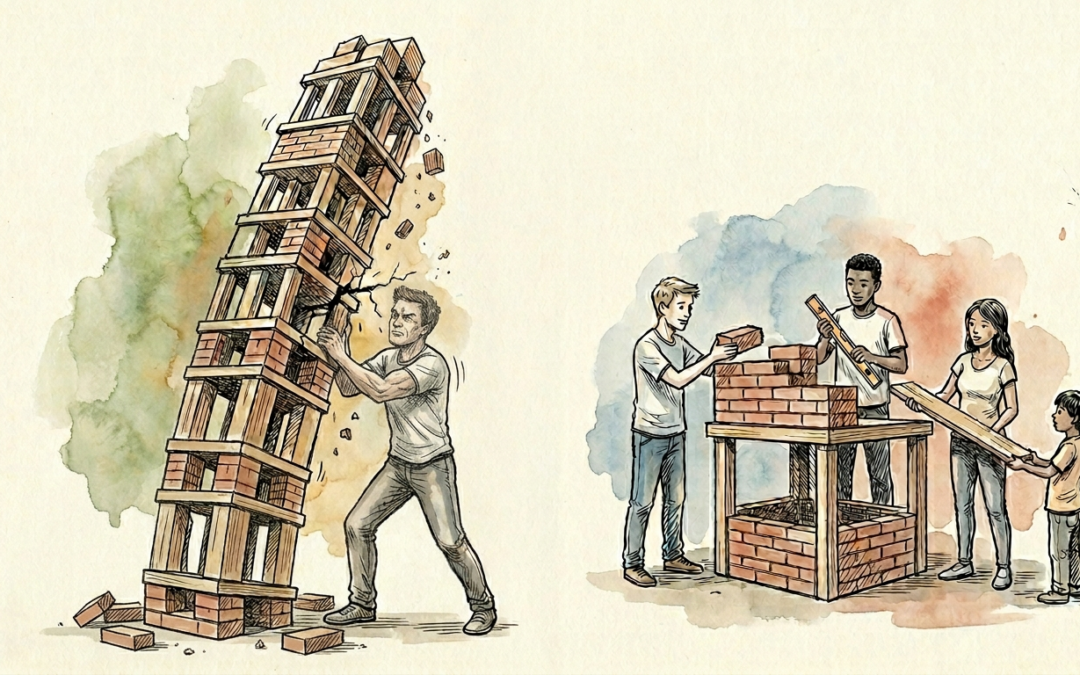
There are two ways to become someone other people defer to. Researchers have known this for decades. Most men have never been told.
One of them is sold to you constantly. It's loud, marketable, and the entire manosphere is built on it. It works in the short run. It collapses in the long run. Almost everything you've been taught to admire about "powerful men" runs on this engine.
The other is quieter. Doesn't make for good content. Compounds slowly and then all at once. Survives the things that destroy the first one — age, illness, setback, market crash, a bad year. Most of the men you actually respect in your real life — not the ones on your phone, the ones in your life — got their respect through this second pathway, even if they couldn't tell you what it was called.
The first is dominance. The second is prestige. They look similar from the outside for a few years. They diverge violently after that.
Let's talk about why.
The Two Engines
Dominance is status through fear. People defer to you because they're afraid of what happens if they don't. The deference is real. The respect underneath it is not.
Prestige is status through value. People defer to you because they want something from being near you — knowledge, skill, opportunity, an example to learn from. They're not afraid of you. They're choosing you.
Both produce the same surface behavior. People listen when you talk. People go along with what you suggest. People treat you as someone who matters. From the outside, in a single meeting, you often can't tell which engine is running.
But the engines are wired to opposite power sources. Dominance runs on threat. Prestige runs on contribution. Threat has to be constantly maintained, refreshed, performed — because the moment the threat weakens, the deference disappears. Contribution accumulates. Every time you help someone succeed, every time you teach a useful thing, every time you show up reliably, prestige stacks. It doesn't have to be re-earned each morning. It just sits there, doing its work in the background of your reputation, even when you're asleep.
This is why the two pathways have completely different shapes over time.
Dominance peaks early and slides down. The young man who becomes the most aggressive guy in the room is often impressive at twenty-five, suspect at thirty-five, exhausting at forty-five, and pitiable at fifty-five. The performance gets harder to maintain as his body changes, his energy drops, and the people around him stop being intimidated. The threat that used to work doesn't.
Prestige curves the other way. It compounds. The man who quietly builds skill, helps people, and keeps his word is often unremarkable at twenty-five — nobody talks about him, he's not the loudest in the room. By thirty-five, people are starting to call him for advice. By forty-five, he's the guy who gets things done in his industry. By fifty-five, his name opens doors he never has to knock on. The work he did at thirty is still paying him at fifty.
Same starting line. Two completely different finish lines.
The dominance pathway has a hidden invoice. Nobody mentions it in the marketing.
To run on dominance, you have to be on. Always. Because the moment you're not performing — the moment you're tired, sick, vulnerable, off your game, having a bad week — the threat weakens, and the deference starts to slip. People who were complying because they were afraid of you stop being afraid the second you show weakness.
So the dominant man can't rest. Can't be openly tired. Can't admit confusion. Can't say "I don't know." Can't be wrong without it costing him. Every interaction is a small performance with the stakes of his entire identity attached. He has to win every disagreement, hold every frame, project authority constantly, never give an inch.
That's exhausting in a way most men don't fully feel until they've been doing it for a decade. Then it shows up as burnout. As insomnia. As the inability to relax even when nothing is wrong. As friendships that never deepened because you couldn't let your guard down. As a marriage where your wife stopped trying to know you because you wouldn't let her in. As a body that's running on cortisol and a brain that won't stop scanning for threats.
Then there's the loyalty problem.
People who comply through fear don't stay loyal. They stay until something better comes along, or until they sense weakness, or until your power slips. And then they remember. They remember every time you talked down to them. Every time you took credit for their work. Every time you used them as a stepping stone. They remember it all, and they wait, and the day your dominance falters, they're not on your side. Some of them actively help push you down.
The dominant man builds an empire of compliance and a graveyard of allies. The day the empire shakes, there's nobody in the graveyard who'll come help.
This is the part the alpha framework never tells you. It sells you the rise and hides the fall. It shows you the snarling wolf at his peak and skips the part where everyone he intimidated is waiting in the trees.
The prestige pathway is slower. That's the first thing to be honest about.
You don't get the early rush. You don't get the immediate deference. For a long time, you're just the guy who's getting good at something while other people are getting loud about something. The guy projecting dominance gets noticed first. He gets the early promotions, the early girlfriends, the early attention. You're still working on the actual skill.
This is where most men quit prestige. The early returns look weaker. The dopamine is delayed. It looks like the loud guys are winning, and you start to wonder if you're falling behind by trying to do it the right way.
You're not falling behind. You're laying foundation.
Here's what's happening on the prestige pathway, even when nobody's watching.
You're getting actually good at something. Not performatively good — actually good. The kind of good that holds up when tested. The kind that other people in your field can recognize even if the public can't yet.
You're building a reputation through small, repeated interactions. You showed up. You followed through. You shared credit. You gave somebody good advice. You introduced two people who needed to meet. None of these moments make a viral post. All of them make a man whose name carries weight.
You're accumulating allies, not subordinates. The people you helped become someone aren't beneath you in a hierarchy. They're in your network, doing well, occasionally calling you when they need something or have something to offer. The man with three hundred subordinates and the man with thirty allies look similar at thirty. They look nothing alike at fifty.
You're developing the kind of confidence that doesn't need to perform. Because your status isn't held up by intimidation, you don't have to maintain a face. You can be wrong without it costing you. You can say "I don't know" without losing standing. You can be tired in front of people. You can be human.
That last one is the underrated benefit. Prestige lets you rest. Dominance never does.
The Workplace Test
Watch this play out in any company.
The dominance guy is loud in meetings. Interrupts. Takes credit, explicitly or by implication. Punishes disagreement, even subtly. Cultivates an air of being slightly dangerous to cross. Often gets promoted because he projects what naive observers mistake for leadership: certainty, volume, willingness to push.
His team complies. They have to. They also share information minimally, hide problems from him until they explode, leave the company at higher rates, and won't go to bat for him when things go wrong. When the reorg comes — and the reorg always comes — nobody senior is calling to say he's indispensable. He gets cut, or sidelined, or watches a younger version of himself rise to take his spot.
The prestige guy is the one his colleagues call when they're stuck. He's the one who actually knows how the system works. He gives credit upward and outward, and somehow this doesn't diminish him — it does the opposite. People want to be on his projects because his projects ship and his teammates get promoted. He's not the loudest in any meeting, but when he speaks, the room actually shifts.
He gets promoted slower at first. By year ten, every senior person at the company has worked with him at some point and quietly made a note to keep him close. By year fifteen, he's the person other companies are trying to poach. By year twenty, he's the guy who can pick his next role because everyone he's ever helped has gone on to become someone who can hire him.
The dominance guy peaked at the director level and got bitter. The prestige guy is running something he loves with people who want to work with him.
This pattern is so consistent across industries, across decades, across cultures, that it's strange we have to keep explaining it. But the dominance model is louder. So young men keep choosing it.
Don't be one of them.
The Dating Test
Same pattern, different arena.
The dominance pathway in dating: manufactured scarcity, neg the woman, run "frame control," play status games, withhold affection strategically, project an air of having more options than you have. Some of this generates short-term attraction, especially in young women who haven't seen the routine yet.
It also produces a particular kind of relationship. One where she's never sure of you. One where you're never quite present, because presence would break the frame. One where intimacy can't deepen because intimacy requires safety, and dominance forecloses safety. One where, if she ever gets her footing — gains a career, gains friends, gains a sense of her own worth — she leaves. And you're back to running the same routine on someone new, ten years older, with diminishing returns.
The prestige pathway in dating: become someone genuinely worth being with. Develop a life she'd want to be part of. Be reliable. Be honest. Be present. Be capable of holding your own emotions without dumping them on her or shutting them down entirely. Be someone whose word means something.
This is harder. It requires actually becoming someone, not just performing someone. It also produces a completely different kind of relationship. One where she chose you and keeps choosing you. One where the relationship deepens instead of decaying. One where, when life gets hard — and life will get hard — you have a partner instead of a hostage.
The men who run dominance game spend their thirties recycling. The men who built prestige spend their thirties married to people they actually like.
The marketing won't tell you this. The marketing sells the dominance routine because the dominance routine sells courses. The prestige pathway can't be sold because it's not a routine. It's a way of becoming. There's no upsell on becoming.
Why our Culture Still Teaches the Wrong One
If prestige is so obviously the better engine, why does our culture keep teaching dominance?
Because dominance is faster, simpler, and more masculine-coded in the short term. It's also enormously profitable to teach.
A young man who decides to build prestige doesn't need a coach. He needs to go become competent at something and treat people well over time. There's no curriculum. No course. No upsell. No "high-value man" workshop.
A young man who decides to build dominance is a perfect customer forever. He needs the body recomp program, the masculinity course, the social dynamics seminar, the supplements, the wardrobe, the watch, the car, the next program after that one didn't work. The dominance pathway requires constant maintenance — and constant maintenance means constant spending.
So an entire industry has reasons to keep telling young men that dominance is the way. Not because it works. Because it sells.
You can opt out of being a customer. Most men don't realize this is even an option.
How to Actually Build Prestige
This isn't complicated. It's just slow.
Get genuinely good at something useful. Not performatively good. Actually good. Pick a domain where the work is hard and the standards are real, and put in the years. Most men want to skip this step. The skipping is why they end up running dominance — because dominance lets you fake the appearance of status without doing the work. Don't fake it. Build the actual thing.
Help people who can't help you back. This is one of the most reliable prestige-builders in any field, and almost nobody does it deliberately because it doesn't pay off in the moment. It pays off in five years, when the junior person you helped has become someone, remembers you, and comes back. Do this for ten years and your network is a forest of grown trees.
Keep your word. Boring. Underrated. Compounds. The men who do what they say they'll do, when they said they'd do it, end up being the men everyone wants in the room. This is so simple it sounds stupid. Almost nobody actually does it consistently.
Give credit. Real credit. Specific credit. Public credit. The men who give credit generously are the men nobody resents and everyone wants to work with. The men who hoard credit poison their own ecosystems and wonder why nobody's loyal.
Be the same person in every room. Reputation transmits faster than you think. The man who is one person to his boss and another to the intern, one person to his friends and another to strangers, one person on his good days and another on his bad — that man will eventually be exposed. The man who is consistent — not perfect, but consistent — earns the kind of trust that no marketing can replace.
Sit with the discomfort of slow returns. This is the hardest one. There will be years where the dominance guys are winning visibly and you're not. Don't switch teams. The graph crosses later than you want it to. But eventually, It does cross.
Every interaction you have is a small vote for one engine or the other.
When you walk into a meeting, are you trying to look like the most important person in the room, or are you trying to make the meeting better? When you meet a new man, is your first calculation "is he above or below me," or is it "what could we do together?" When someone on your team does great work, do you find a way to be in the credit, or do you find a way to give it to them?
Every one of those small choices is wiring one engine or the other. Over a decade, they aggregate into a man.
You don't get to wake up at forty and decide which kind of man you are. By forty, you already are one. The choice is happening now, in the small moments, the ones that don't feel like choices.
The dominance engine promises you status, and delivers a performance that costs you everything else. The prestige engine asks you to do the unglamorous work of becoming actually valuable, and quietly delivers the durable respect, real relationships, and earned authority the dominance engine only mimics.
One of these collapses the day you can't perform anymore. The other one is still working when you're seventy.
Pick the one that's still working when you're seventy.
Build accordingly.
---
Practice prompt: Think about the last time you walked out of an interaction feeling like you "won." What did winning look like? Did you make the other person smaller, or did you actually contribute something? Now think about the man you most respect — not the most impressive man you can think of, the one you actually respect. Replay one of your interactions with him. Was he winning, or was he building? What does that tell you about which engine he's running, and which one you're running?