
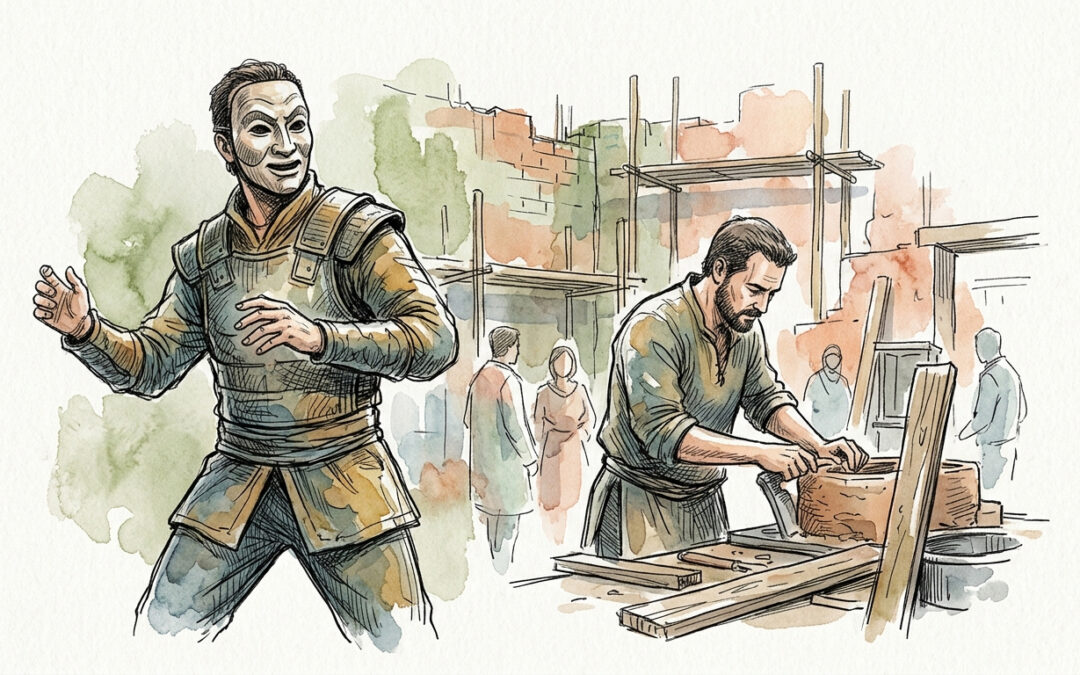
Here is the pitch: confidence is a state you project. You walk a certain way. You talk a certain way. You hold eye contact two seconds longer than feels natural. You never apologize. You never hedge. You take up space, speak first, laugh off criticism, and keep your face neutral when someone challenges you. Do this consistently enough, the pitch goes, and people will perceive you as confident — and perception is reality.
The pitch works because it solves a real problem badly. You know what it feels like to be uncertain in a room. To shrink when you should speak. To rehearse what you'll say before you say it, then listen to yourself say it wrong. That's a genuine cost. The promise of a shortcut — a posture, a habit, a script — is genuinely appealing when the alternative feels like years of grinding work.
But here's what performed confidence actually delivers: a permanent job you never get to quit.
You have to maintain it constantly. Every interaction becomes an audition. Every moment you relax is a moment someone might see through the performance. And underneath the performance, the original problem — the uncertainty, the doubt, the feeling that you're not quite solid enough — hasn't moved. You've just built a facade over it. Facades don't fix foundations. They hide them until they collapse.
Real confidence is not something you project. It's something you earn. It's the natural byproduct of doing actual work — building competence, keeping your word, giving a damn about people beyond what they can do for you. Not a mask. Not a posture. A structural outcome.
This distinction is the whole argument. Let's build it out.
The Performance Tax
Performed confidence extracts from you constantly.
You're monitoring every room for signs that the performance is landing. You can't ask a question that might reveal a gap in your knowledge — asking questions looks uncertain. You can't admit you were wrong about something — admitting error looks weak. You can't be genuinely curious about another person — being curious puts them in the dominant position. Every conversation is a status negotiation. Every interaction is a test.
This is exhausting. And it's supposed to be. That's the point — not your point, but the point of the people selling you the performance. Anxious men are good customers. Men who are perpetually uncertain whether they're confident enough will buy the next course, the next framework, the next set of scripts. Your insecurity, kept alive and productive, is the business model.
The performance tax shows up in your relationships too. You can't be known. Being known means someone sees you uncertain, sees you wrong, sees you struggling — and struggling is not part of the performance. So you keep people at distance. You give them the version you've constructed. And over time you build relationships with people who know your facade, not you, which means they can't actually support you when things go hard, which means you're performing alone.
That's the destination the performance delivers. Not confidence. Not respect. Just isolation with a good poker face.
What Competence Actually Does
Here's what nobody tells you about becoming good at something: it changes your nervous system.
Not metaphorically. When you've actually built a skill — when you've done something difficult enough times to get good at it, when you've failed and adjusted and failed again and adjusted again — your body carries that differently. You stop bracing for exposure. You stop waiting for someone to discover you don't know what you're doing. You know what you're doing. Not perfectly, not completely, but genuinely.
That shift is structural. It's not about how you carry yourself. It's about what you actually know when you walk into a room.
The earlier post on the alpha myth has it right: real confidence doesn't announce itself. The man who's deeply skilled at something valuable, who knows his capabilities and limitations, who doesn't need to tell you he's competent because his competence is evident — that man is magnetic. Not because he's performing anything. Because he's real.
Competence also does something the performance can't: it makes you curious instead of defensive. The man who's genuinely good at his work can ask a question without it threatening his status. He can say "I don't know how to do that yet" without it destabilizing him. He can let someone else be the expert in a room without interpreting it as an attack. This is what competence buys you — not the performance of certainty, but the actual security of knowing what you've built and what you haven't.
The work is slower. You can't acquire competence over a weekend. You can't shortcut it with mindset shifts. You have to actually do the thing, badly at first, then less badly, then with some fluency, then with genuine skill. That's months. Often years. There's no faster path that doesn't leave you back where you started — performing certainty over a hollow foundation.
Build competence. It compounds. Performance costs you compound interest.
Integrity Is Not a Virtue Speech
Integrity gets used as a synonym for "being a good person," which makes it sound like something on a motivational poster. That's not what it is.
Integrity is structural. It means your actions match your words. It means when you say you'll do something, you do it. When you say something is true, it's true. When you take on a commitment, you carry it.
The reason integrity produces confidence is mechanical. When you consistently do what you say you'll do — when your internal and external reality align — you stop experiencing the low-grade cognitive dissonance of being one person privately and performing another publicly. That dissonance is expensive. It eats energy, creates anxiety, makes you defensive when challenged because you're always partly braced for the gap to be exposed.
Close the gap and the defensiveness goes. Not immediately. Not completely. But directionally. Men who operate with integrity aren't braced against exposure because there's nothing to expose. They are, approximately, who they appear to be.
This is also why integrity makes you trustworthy in ways that performance can't manufacture. People don't consciously audit whether you're keeping your word. But they register it. They know, from accumulation of small evidence, whether your yes means yes, whether your no means no, whether you show up when you said you would. That evidence builds into a reputation, and that reputation is the actual foundation of influence — not posturing, not volume, not performing authority.
The man people follow because they've seen him be reliable, be honest, be accountable when he got something wrong — that man has something the performer doesn't. He has a track record.
Track records take time. They're not glamorous. Nobody's selling a course on consistently keeping small promises over a period of years. But that's what actually builds the thing the courses promise to sell you.
Care Is Not Weakness. It's Leverage.
There's an idea in the spaces that sell performed confidence that caring is subordinate — that the man who cares more in any relationship is the one with less power, that emotional availability is a negotiating liability, that giving a damn about people costs you status.
This is wrong. Not wrong because it's mean. Wrong because it doesn't describe how people actually work.
People are drawn to competent men who give a damn about them. Not as a strategy. Not as a performance of giving a damn — people can tell the difference between genuine attention and someone running a rapport-building script. But actual care, actual curiosity about who someone is, actual investment in their wellbeing — that's the thing that makes someone's presence feel safe, and people move toward safety.
Real confidence is generous. That's one of its defining features. The man who's genuinely secure in his competence isn't threatened by helping others become competent. He teaches, mentors, shares what he knows — not because he's performing generosity, but because his position isn't threatened by others' success. He doesn't need to hoard or posture. He's not monitoring relative status. He's just doing the work.
Compare that to the man performing confidence. He can't teach because teaching requires acknowledging that someone else doesn't know something he knows — and that requires him to be in a position of visible superiority, which requires constant management. He can't be genuinely curious about other people because curiosity positions the other person as the one who knows. Every interaction costs him something. Care is impossible because care requires your full attention to be on someone else, and he can't afford to look away from the performance.
Caring actually frees you from that. When your confidence is genuine — when it's built on real competence and real integrity — you can afford to give people your actual attention. And that attention is, genuinely, rare. Most people spend their lives not being fully heard. The man who listens — actually listens, not as a technique — becomes someone people want to be around. That's not manipulation. That's what happens when presence is real.
The Man Who Doesn't Need to Win the Room
You've met him. He's not the loudest. He might not even be the most obviously impressive. But there's something about being around him that settles you. You trust him quickly. You're not performing for him.
Part of that is competence — you can tell he knows what he's doing. Part of it is integrity — you've seen him be honest when honesty was costly. Part of it is the care — he actually seems interested in you, specifically, as a person rather than as a means to something.
What he doesn't do is perform. He doesn't work the room. He doesn't make sure you know his accomplishments. He doesn't get defensive when challenged. He doesn't need to be the smartest voice in the room or land the best joke. He can be wrong and say so. He can say "I don't know" and not treat it as a wound.
That security — the security of not needing to win — is what performed confidence is trying to buy at a discount. The performer has figured out that secure men project a certain kind of ease, and he's reverse-engineered the projection. The problem is projection without foundation is just performance, and performance without foundation is just waiting to be exposed.
You can't shortcut your way to the thing he has. You can only build toward it — slowly, through actual work, actual kept promises, actual time spent caring about people without an agenda. The outcome is the same. The path is longer and less marketable.
What You're Actually Building
Confidence built on competence, integrity, and care does something performed confidence can't: it compounds.
The more competent you become, the more genuinely secure you get. The longer your track record of integrity holds, the more people trust you — and the easier everything becomes, because trust is friction-reducing. The more you practice actually giving a damn about people, the better you get at it, and the more magnetic that becomes.
Performed confidence doesn't compound. It maintains. You have to keep performing at roughly the same intensity indefinitely, because the moment you stop, the structure underneath is still the same hollow foundation. There's no accumulation. Just maintenance.
The harder path — the path of actual competence, actual integrity, actual care — is the one that gets easier. Not immediately. Not for a while. But directionally, over time, the man who builds real confidence is doing less work to hold himself together than the man who performs it. Because the real thing holds itself.
You're not trying to look confident. You're trying to become someone who earns the right to feel it.
That's a different project entirely. It takes longer. It can't be sold in a weekend course.
It's also the only one that works.
Practice prompt: Think of someone in your life whose confidence you respect — not someone impressive, but someone you genuinely trust. What is it, specifically? Is it how they carry themselves, or is it what you've seen them do? Now ask: is what I'm currently building moving me toward that, or away from it?