
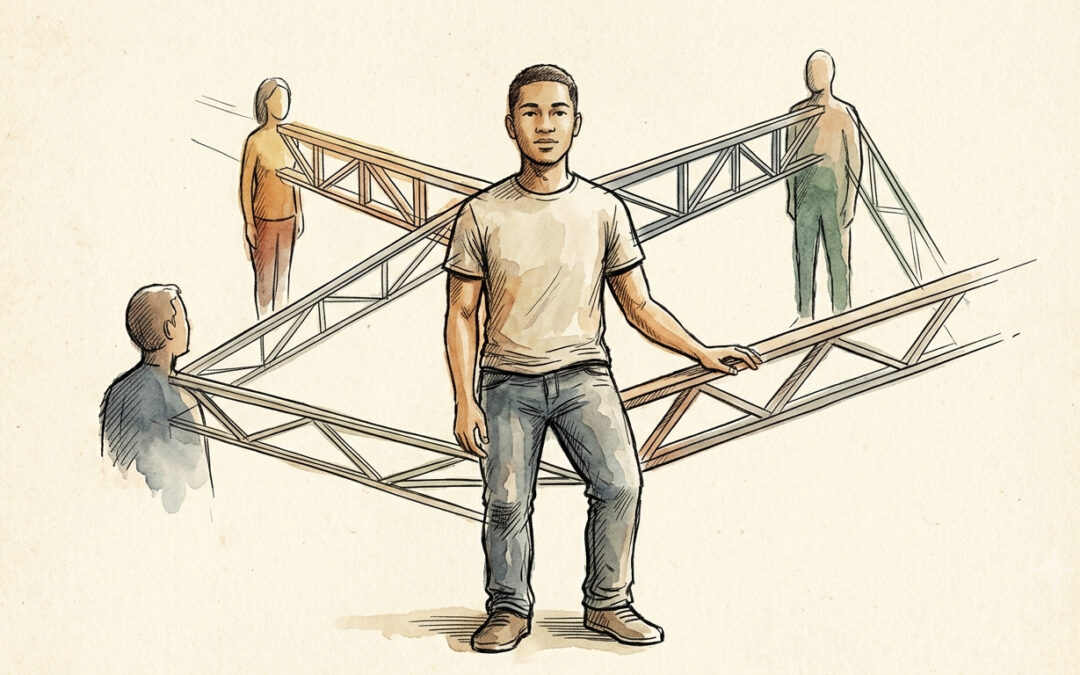
The script is simple, and it sounds like strength. You don't need anyone. Handle it yourself. A man who leans on other people is a man who hasn't figured out how to stand on his own. Emotional intimacy is for women. What you need is independence — the quiet competence of a guy who doesn't burden anyone with his problems.
It's a clean pitch. It hands you a way to read your own isolation as achievement. You're not lonely, you're self-reliant. You don't have close friends because you've outgrown the need, not because you never learned how to build them. Every empty evening becomes evidence of your strength instead of a signal that something's missing.
That's exactly why it's dangerous. The script isn't describing strength. It's describing a structural failure and telling you to be proud of it.
Male loneliness isn't a feature of healthy masculinity. It's a bug in a broken system — a design flaw copied and passed down so many times that nobody stops to inspect it. And the cost of believing otherwise is the thing itself: isolation, dressed up as independence, standing there quietly until the day you reach for support that was never built.
The Script You Were Handed
Somewhere along the way you absorbed a set of rules nobody wrote down. Needing people is weakness. Emotional closeness is feminine. A real man is a closed system — takes inputs, produces outputs, requires no maintenance from anyone.
You weren't taught this in a lecture. You learned it from what got mocked and what got rewarded. You learned it the first time you said something vulnerable and watched a room get uncomfortable. You learned it from every movie where the hero handles the whole thing alone and every older man who answered "how are you" with "can't complain" for forty years straight.
So you built accordingly. You got good at banter and bad at disclosure. You collected activity partners — guys you golf with, drink with, watch the game with — and called them friends, because on paper they are. You learned to keep everything at the surface, where it's safe, and you told yourself that was just how men are.
Here's the part the script leaves out. It's not describing your nature. It's describing your training. You're not less capable of connection than anyone else. You were handed a blueprint that treats connection as optional, and you've been building to spec.
The blueprint is wrong. It was wrong before it got to you.
What the Data Actually Says
If the isolation were really strength, it would show up as thriving. It doesn't. It shows up as collapse.
The share of American men who say they have no close friends at all rose from 3 percent in 1990 to 15 percent by 2021, according to the Survey Center on American Life. Not fewer friends. Zero. A fivefold jump in one generation. And the men who do have friends report being less emotionally connected to them than women are to theirs — more likely to keep the friendship parked at the level of activity and banter, never routed toward anything that could hold weight.
Notice what the number is not. It's not evidence that men have transcended some need. It's evidence of a need going unmet on an industrial scale. Men aren't lonelier because they're built to need less. They're lonelier because they were trained to want less out loud, and then left to deal with the shortfall in private.
Decades of research on male mental health, on social isolation, on suicide rates, all point the same direction. Isolated men are not healthier. They're not more resilient. They are more fragile, more depressed, more likely to fall hard when one relationship fails, because they built their entire support structure on a single beam. Connection isn't the thing strong men can do without. It's load-bearing. Pull it and the structure doesn't get leaner. It cracks.
The data doesn't say men are weak. It says the script is lying, and men are the ones paying for the lie.
Independence Is Not the Same as Isolation
This is where the sleight of hand happens, so watch it closely.
Independence is a genuine strength. Being able to cook, pay your bills, sit alone without falling apart, make decisions without a committee — that's real, and worth building. Nobody's arguing you should be dependent.
But the script doesn't sell you independence. It sells you isolation wearing independence's clothes. It takes a real virtue and quietly swaps in a counterfeit, betting you won't check the label.
Independence means you can stand on your own when you have to. Isolation means you have to, always, whether you want to or not, because there's no one else holding anything up. One is a capability. The other is a single point of failure.
Think about how you'd design any system that actually needed to survive. You'd build redundancy. You wouldn't run an entire city's power through one line and call it lean. You'd hate that design. You'd flag it in the first review.
Now look at how most men are wired for support. One relationship — maybe a partner, maybe one friend from childhood — carrying the entire emotional load. No backup. No redundancy. And if that one line goes down, through a breakup or a death or just slow drift, the whole grid goes dark at once. That's not strength. That's a brittle system one failure away from collapse, and the script talked you into calling it self-sufficiency.
Interdependence isn't the opposite of independence. It's what independence looks like when it stops being fragile.
Infrastructure, Not Entertainment
Here's the reframe that changes what you're actually building.
Most male friendship is entertainment. People you do things with. People who are around when it's fun and gone when it's hard. That's not an insult — entertainment makes life better, and there's nothing wrong with a friend you only ever golf with. But entertainment doesn't hold weight. When the difficult thing comes, and it always comes, an activity partner isn't going to be there at 11 p.m. when you need someone who knows the whole story.
Infrastructure is different. Infrastructure is the roads and the water lines and the power grid — the stuff you never think about until it fails, and then it's the only thing that matters. Friendship as infrastructure is the relationship that can carry you through loss, failure, the ordinary grinding difficulty of being a person. You don't build it through intensity or grand gestures. You build it the way you build anything load-bearing: consistency over time.
The grand gesture is easy and mostly hollow. Showing up for the funeral when you haven't texted in six months is a performance, not a friendship. The real work is smaller and far less dramatic. The text that says thinking of you. Remembering to ask how the thing went. The twenty-minute call for no reason. None of it is hard in the moment. What's hard is doing it for years, with no crisis forcing it and no reward for it, until you've quietly built a relationship both of you know can take the weight.
That's the difference between someone you hang out with and someone you can count on. And you don't find out which one you built until the day you need to know.
Going First
Infrastructure doesn't appear on its own. Someone has to lay the first line, and with the training you've got, that someone is going to have to be you.
Depth in a friendship runs on one mechanism: reciprocal vulnerability. One person says something real — not the facts of their life, but how they actually feel about those facts — and the other person receives it without mockery or deflection, and maybe offers something real back. Trust compounds. The friendship develops the capacity to hold more. That's the entire skill. It's not complicated. It's just uncomfortable, because it requires someone to go first without knowing how it'll land.
Most men won't go first. Going first feels like exposure — what if he thinks I'm weak, what if it changes how he sees me. So two guys who'd both take a real conversation sit across from each other for years and never have one, each waiting for the other to break the seal. The friendship stays parked at banter, not because either man wants it there, but because neither will risk moving it.
Be the one who moves it. Not oversharing, not turning coffee into a therapy session. Just being honest about something true, at the right moment, with someone who's earned it. "Want to actually catch up?" is a legitimate thing to say. "That's been harder than I've let on" is a legitimate thing to say. The worst case is the friendship stays exactly where it already is. The best case is you build something that can hold weight.
And you can be blunt about the intent. "I value this and I want to keep it strong" violates every unwritten rule you were handed. It's also just honest, and it gives the other guy permission to invest too — permission he was probably waiting for.
The Trade You're Actually Making
None of this is free, and pretending it is would be its own kind of grift.
Building connection as infrastructure is work — real, ongoing, often thankless work, in an environment that stripped out the structures that used to make it automatic. There was a time when friendship came bundled with the church, the union hall, the neighborhood, the job you kept for thirty years. Most of that scaffolding is gone. So now you have to do deliberately what used to happen by default, and yes, that's harder than it should be. That difficulty is real. It's also not a reason to quit. It's just the current conditions, and the conditions don't care whether they're fair.
And it will feel wrong at first. Going first, naming that you need this, letting someone see something true — every bit of it cuts against deep conditioning, and it'll feel exposing, like you're doing something you shouldn't. That discomfort isn't a warning. It's the design flaw being challenged. It's what pushing against a wrong blueprint actually feels like.
So sit with the trade honestly. On one side: the work, the awkwardness, the risk of going first and not being met. On the other: the script's version, where you keep performing self-sufficiency, keep everything at the surface, keep telling yourself the isolation is strength, right up until the weight comes and there's no one to help you carry it.
That's the whole choice. It was never independence versus dependence. It was infrastructure versus collapse, and the script had you building toward collapse the entire time.
Loneliness is not a character flaw. It's a structural outcome — the predictable result of a blueprint that told you connection was optional and left you to absorb the cost of the lie. Understanding that changes what you blame yourself for. You didn't fail at connection because something's wrong with you. You were handed a broken design and told it was strength.
You're the builder now. The blueprint is yours to change.
Build the infrastructure before you need it. That's the whole job.
Practice prompt: Think about the last time you kept a conversation at the surface when it could have gone deeper — the moment a friend said something real and you reached for a joke, or said something real yourself and immediately walked it back. Replay it. Not to feel bad about it, but to notice: what were you protecting, and what did it cost you? That flinch is the design flaw. Now you know where the next brick goes.