
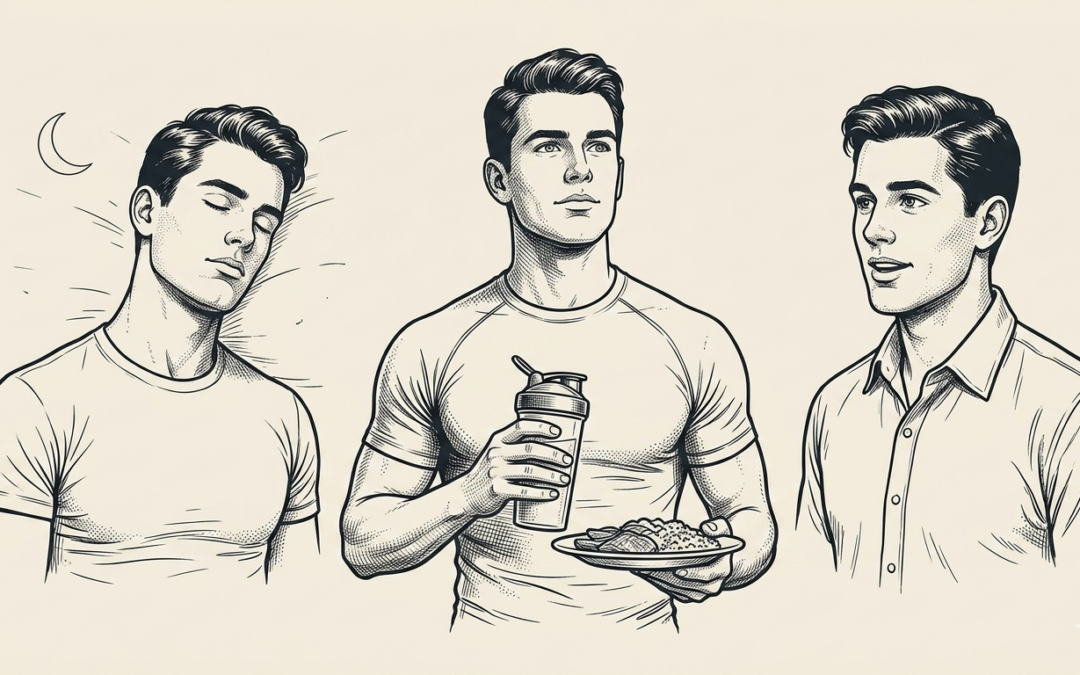
The Modern Trap
Here's what's actually happening to most guys your age.
You're staying up until 2 a.m. — not doing anything particularly great, just scrolling. You're eating whatever's fastest. You're technically "connected" to hundreds of people online and genuinely close to almost none of them. You're tired in a way that sleep doesn't seem to fix. You're building something, sure — but what? A watch history? A body that runs on caffeine and convenience?
We didn't design this trap. But we're living in it.
The algorithm is optimized for your attention, not your development. The food environment is engineered for repeat purchases, not performance. The loneliness epidemic is real — and for men 18–25, it's hitting hardest. This isn't a character flaw. It's a systems problem.
But here's the thing about systems: you can opt out.
Not perfectly. Not all at once. But you can build a counter-system — a foundation so solid that the noise stops mattering as much. That foundation has exactly three pillars. Master them, and you'll be operating at a level most guys your age won't even understand yet.
This is the 19–25 window. You will never have this hormonal environment again. Let's not waste it.
The Big Three
PILLAR ONE: Sleep (7–9 Hours)
Your Brain Has a Cleaning Crew. Stop Firing Them.
Most guys treat sleep like it's wasted time. That's one of the most expensive mistakes you can make at this age.
While you sleep, your brain activates the glymphatic system — essentially a biological pressure-wash for your neural tissue. Cerebrospinal fluid flushes through the brain, clearing out metabolic waste products that accumulate during waking hours, including the proteins linked to cognitive decline. This process is dramatically more active during sleep than wakefulness. You are literally detoxifying your brain every night — or you're supposed to be.
Cut sleep short and that waste accumulates. Brain fog, poor decision-making, emotional dysregulation — this isn't weakness. It's chemistry.
And that's before we talk about hormones.
Between 19 and 25, you are in the peak window for growth hormone secretion. The largest pulse of GH your body produces happens during deep, slow-wave sleep — specifically in the first few hours of the night. Growth hormone is the signal that drives muscle repair, fat metabolism, and tissue recovery. Every late night is a direct tax on that system.
Testosterone follows the same logic. Sleep deprivation drops testosterone levels measurably — some studies show a 10–15% drop after just one week of restricted sleep. You are not going to out-supplement, out-train, or out-grind a chronic sleep deficit. The guys who look like they have a genetic advantage? A significant portion of that "advantage" is recovery.
The How:
- Lock in a consistent wake time first. Everything else follows.
- Kill screens 30–60 minutes before bed — not because it's trendy, but because blue light suppresses melatonin onset.
- Keep your room cold and dark. Your core body temperature needs to drop to initiate deep sleep.
- Avoid alcohol near bedtime. It sedates you but fragments your sleep architecture — you miss the restorative deep stages.
Sleep isn't passive. It's the most anabolic thing you can do tonight.
PILLAR TWO: Protein (~0.8–1g Per Pound of Bodyweight)
You Are Literally Building the Body You'll Inhabit for 60 Years.
Think about this seriously for a moment.
The body you're walking around in right now is under constant construction. Muscle fibers are being broken down and rebuilt. Bone density is still increasing — your peak bone mass isn't set until your mid-to-late twenties. The structural decisions you make right now — through training and nutrition — will echo for decades.
This isn't a fitness aesthetic conversation. It's a structural integrity conversation.
Protein is the raw material. Without adequate protein, your body cannot complete the rebuild. It's like trying to construct a building while the supply chain is running at half capacity. You'll get something — but it won't be what you designed.
The target is straightforward: 0.8 to 1 gram of protein per pound of bodyweight per day. If you weigh 175 lbs, that's 140–175g of protein daily. That number likely sounds high if you've never tracked it. Most guys eating casually land around 60–80g — less than half of what drives optimal muscle protein synthesis.
At your age, your anabolic response to protein is near its lifetime peak. You are more sensitive to protein signaling right now than you will be at 35, 45, or 55. The guys who build a serious physical foundation in this window carry those advantages forward for the rest of their lives. The guys who coast on youth and assume they'll "get serious later" find out that later costs more.
The How:
- Anchor every meal around a protein source first. Build the rest of the plate around it.
- Aim to distribute protein across 3–4 meals rather than loading it all at once — muscle protein synthesis responds better to distribution.
- Priority sources: eggs, chicken, beef, fish, Greek yogurt, cottage cheese, legumes combined with grains. Real food first; shakes as a supplement, not a substitute.
- If you're training seriously, protein timing around your workout matters — but hitting your daily target matters more than timing.
This isn't about getting big for its own sake. It's about building a body that performs, recovers, and holds up. You are in the window. Use it.
PILLAR THREE: Social Connection (One Real Hangout Per Week)
Loneliness Isn't Just Uncomfortable. It's Killing People.
Here's a stat that doesn't get enough attention:
Chronic social isolation carries a health risk comparable to smoking 15 cigarettes a day. We're not talking about psychological discomfort — we're talking about cardiovascular risk, immune function, inflammation markers, all-cause mortality. Loneliness is a physiological stressor.
For young men specifically, this is a crisis hiding in plain sight. You can have 800 followers and no one to call when things go sideways. You can spend four hours a day consuming content made by other people living their lives while yours sits idle. The digital world creates a convincing simulation of connection while the real infrastructure quietly decays.
Here's what we know from the science and from the data Keith Wilson captures in Built Different: men were never designed to build connection through performance and status. The old script — dominate, compete, never show weakness — was always hollowing men out. It's just that now, without the structural connections that used to exist by default (neighborhoods, trades, community organizations, physical workplaces), there's nothing left to fall back on.
One real hangout per week isn't a soft suggestion. It's a minimum viable dose of what your nervous system was built to run on.
"Real" means in-person. It means a conversation where both people are present, not performing. It means something slightly uncomfortable, maybe — reaching out, making the plan, showing up when it's easier not to.
The How:
- Recurring beats spontaneous. A standing weekly commitment (same sport, same night, same activity) removes the friction of re-initiating every time.
- Choose activities that lower the pressure of direct conversation — lifting together, playing basketball, cooking, building something. Side-by-side connection is how men naturally bond.
- Depth over breadth. One honest conversation matters more than ten surface-level check-ins.
- If you're starting from close to zero: look at recurring, activity-based groups. Martial arts gyms, climbing walls, recreational sports leagues, volunteer organizations. Proximity plus repetition plus low stakes is the formula.
You don't have to be naturally social. You have to be willing to show up consistently. That's the whole skill.
The Mentality: Mental Fitness Is Physical
We need to say this clearly: a strong body and a strong mind are not separate projects.
The same sleep deprivation that degrades your physical performance also degrades your emotional regulation, your decision-making, and your resilience under stress. The same isolation that increases cardiovascular risk also drives depression and anxiety. These systems are not parallel — they're integrated.
Resources like HeadsUpGuys (headsupguys.org) and HealthyGamerGG (healthygamer.gg) are worth knowing. Not because you need to be in crisis to use them, but because mental performance optimization is just as legitimate as physical performance optimization. HealthyGamer in particular approaches mental health through a lens that resonates with this demographic — scientific, practical, without the clinical distance that makes a lot of guys tune out.
The Built Different framework — the one Keith Wilson has spent a decade building with young men at the ground level — makes the same point from lived experience. Being Built Different has never been about being born with better genetics or a better situation. It's about choosing, repeatedly, the harder path over the easier one. Choosing sleep over the scroll. Choosing the meal prep over the drive-through. Choosing to text the friend and actually show up.
Digital distraction isn't just a productivity problem. It's a development problem. Every hour spent in passive consumption is an hour not spent building anything real — in your body, your relationships, or your character.
That choice is available to you right now. Every day.
The 21-Day Challenge
Here's where we stop talking about it.
For the next 21 days, track these three metrics. That's it. Nothing else needs to change.
| Metric | Target | Track It |
|---|---|---|
| Sleep | 7–9 hours per night | Notes app, phone Health app, or a cheap tracker |
| Protein | 0.8–1g per lb of bodyweight | Cronometer (free app) — just log for 21 days |
| Connection | 1 real in-person hangout per week | Put it in your calendar before the week starts |
Three metrics. Three weeks. No dramatic overhaul required.
Why 21 days? Because that's long enough to feel a real difference in energy, mood, and physical performance — and short enough that it's not an abstract commitment. You're not signing up for a lifestyle transformation. You're running a 21-day experiment on yourself.
Most guys who do this report the same thing: they realize the baseline they were operating at was significantly lower than they thought. The comparison isn't to some idealized version of themselves. It's to who they were last month.
Keep a simple log. Rate your energy, focus, and mood each day on a scale of 1–10. Watch what happens.
The foundation doesn't build itself.
Nobody's coming to hand you the discipline, the sleep, the protein, or the relationships. But nobody's stopping you from building them either.
This is the window. The hormonal environment, the neuroplasticity, the time before the compounding effects of poor decisions really start to show — this is it.
We're in the trenches with you.
Start tonight.