
I used to think I had an anger problem. Turned out, I had a listening problem.
For years, anger showed up in my life like an unwelcome visitor I couldn't get rid of. It would arrive without warning—a flash of heat when someone interrupted me, a clenched jaw during traffic, a surge of rage at minor inconveniences that I knew, logically, shouldn't matter that much. I tried what most men try: pushing it down, powering through, telling myself to get over it.
The anger didn't go anywhere. It just got louder.
What I didn't understand then was that anger isn't the problem. It's the messenger. And I was shooting the messenger without ever reading the message.
The Iceberg Model: What You See Isn't What You've Got
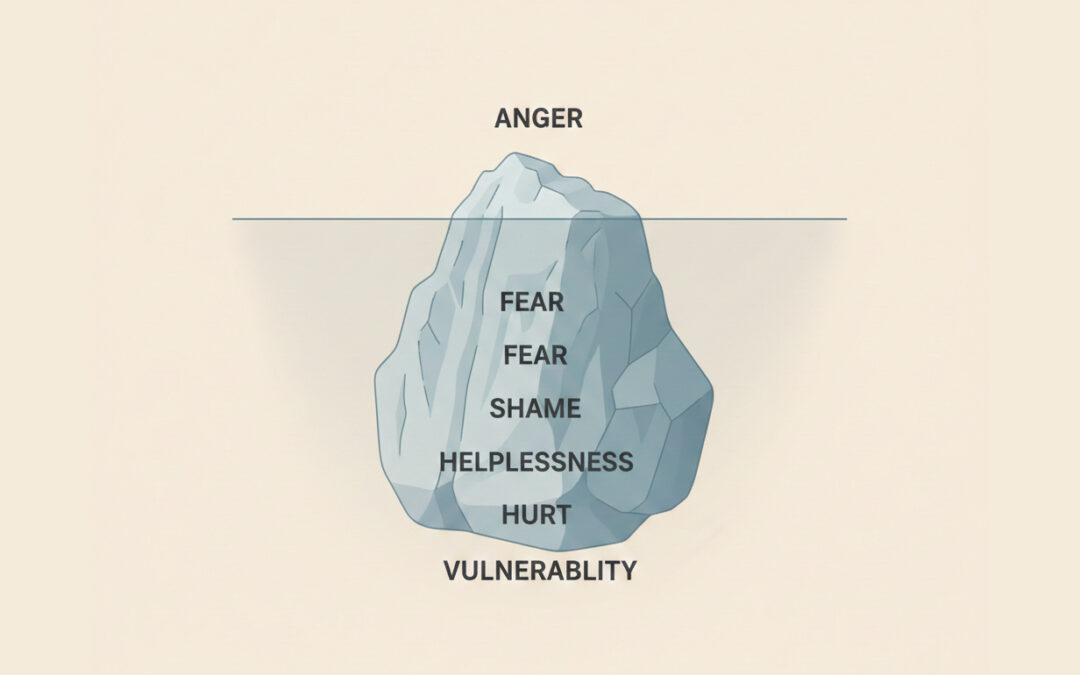
Imagine an iceberg. The part visible above water is anger—the reaction everyone sees, the emotion you feel most immediately. It's right there on the surface: the raised voice, the clenched fists, the heat in your face.
But that visible tip represents maybe 10% of what's actually happening. The other 90% is underwater, hidden from view. And that's where the real information lives.
Beneath anger, you'll almost always find one or more of these deeper emotions:
- Fear (of loss, inadequacy, being out of control)
- Helplessness (feeling powerless to change a situation)
- Shame (believing you're somehow deficient or failing)
- Hurt (emotional pain from feeling dismissed or devalued)
- Vulnerability (exposure to potential harm or rejection)
Anger is actually a protective response. It's your psyche's security system, mobilizing energy to defend against these deeper, more vulnerable feelings. The problem is, most of us never learned to look beneath the surface. We just see red and react.
We see this working with young men at the youth agency. They come in furious—angry at their parents, their circumstances, the world. But when you create space to actually explore what is happening beneath that anger, something else always emerges.
The young man raging about his father's criticism? Underneath is shame about not being good enough and fear that maybe his father is right. The kid furious at being dumped by his girlfriend? Beneath it is hurt at being rejected and helplessness about being unable to make her stay. The teen angry at "everything"? Usually drowning in overwhelm and powerlessness about a life that feels completely out of their control.
The anger is real. But it isn't the root issue—it's the alarm bell trying to get their attention.
For many men, anger is one of the few emotions we get permission to express. Sadness makes you weak. Fear makes you a coward. Shame is something you never admit. But anger? Anger is masculine. Anger means you're strong, that you won't take shit from anyone.
So we learn to funnel everything through anger. Hurt became anger. Fear became anger. Shame, vulnerability, grief, disappointment—all of it gets converted into the one emotion that feels safe to express.
The problem is, anger is a terrible translator. It loses all the nuance, all the specific information your other emotions are trying to communicate. It's like having a vocabulary of one word to describe an entire landscape of experience.
I see this in myself still. When someone in a meeting dismisses my input, my immediate response is irritation. But if I actually pause and check in with myself—really check in—I notice the fear underneath. Fear that I'm not being respected. Fear that my years of experience count for nothing. Shame about maybe not being as smart as I thought.
The anger is there. But it's not the deepest truth. It's just the bodyguard standing in front of the more vulnerable emotions that don't feel safe to acknowledge.
Learning to decode anger isn't about suppressing it or pretending you're not angry. It's about developing curiosity about what your anger is protecting. Here's how to start:
Notice the Physical Signals First
Before you can decode anger, you need to catch it. And anger shows up in your body before it fully registers in your mind.
Learn your early warning signs. For me, it's tension in my jaw and heat rising in my chest. For you, it might be:
- Clenched fists or tightening in your shoulders
- Rapid, shallow breathing
- A feeling of heat or pressure in your head
- Tension in your neck or upper back
- A sudden urge to move or act
The earlier you notice these signals, the better chance you have of working with the anger instead of being hijacked by it.
Create a Pause
This is the hardest and most important step. When anger spikes, your body is flooded with cortisol and adrenaline. Your capacity for complex thinking drops. You're in fight mode, not reflection mode.
You need space before you can decode anything.
This doesn't mean counting to ten (though that's better than nothing). It means actually removing yourself from the triggering situation when possible. Go for a walk. Step outside. Lock yourself in the bathroom for five minutes if that's what you've got.
The goal isn't to calm down completely. It's to get enough distance that your thinking brain comes back online.
Ask the Iceberg Questions
Once you have some space, start investigating what's beneath the surface anger. Ask yourself:
"What am I afraid of in this situation?" Maybe you're afraid of being disrespected, of losing control, of someone thinking you're weak, of being abandoned, of failing at something important.
"Where do I feel helpless or powerless?" Is there something happening that you can't influence or change? Are you up against forces bigger than you? Is someone refusing to see your perspective or acknowledge your needs?
"What hurts?" Did someone dismiss you? Betray your trust? Treat you like you don't matter? Ignore something you care deeply about?
"What makes me feel ashamed or inadequate?" Are you worried you're failing at something? That you're not measuring up? That you're somehow deficient or broken?
"What do I need that I'm not getting?" Respect? Recognition? Safety? Connection? Understanding? Control over your own life?
These questions won't always have immediate answers. Sometimes you need to sit with them. Write in a journal. Talk it through with someone you trust. The act of genuinely asking is more important than finding the perfect answer right away.
Name What You Find
There's surprising power in simply naming the underlying emotion. When you can say—even just to yourself—"I'm angry, but actually I think I'm scared," or "I'm furious, but underneath this is shame," something shifts.
Psychological research confirms this. The act of labeling emotions reduces their intensity and gives you more agency in how you respond. It's called affect labeling, and it's one of the most reliable tools we have for emotional regulation.
Naming doesn't eliminate the feeling. But it changes your relationship to it. You're no longer just swept up in undifferentiated rage. You're someone experiencing fear, or hurt, or helplessness—emotions that have specific information and might call for different responses than anger alone.
Respond to the Real Issue
Once you've identified what's beneath the anger, you can actually address it.
If it's fear, you can assess whether the threat is real or imagined, and take steps to either protect yourself or challenge catastrophic thinking.
If it's helplessness, you can identify what you can and can't control, and put your energy toward the former instead of raging at the latter.
If it's hurt, you can communicate that pain directly instead of attacking the person who hurt you, which usually just creates more hurt.
If it's shame, you can reality-check whether you're actually failing or just holding yourself to impossible standards, and work on self-compassion instead of self-punishment.
The anger might still be present. But now you're working with the full picture instead of just the tip of the iceberg.
What This Looks Like in Practice
A few months ago, I found myself unreasonably angry at my partner over something small—she'd forgotten to pick up something I'd asked for at the store. My immediate reaction was irritation way out of proportion to the situation.
Old me would have either swallowed it and stewed, or snapped at her sarcastically in a way that would have started an argument neither of us wanted.
Instead, I caught the anger signal. Noticed the tightness in my chest. Took a walk outside instead of saying something I'd regret.
On that walk, I asked the iceberg questions. What was I actually afraid of? That I didn't matter enough for her to remember. That I was low on her priority list. What did I need? To feel like I was important to her.
The anger was still there when I got back. But I could talk about it differently. Not "You never listen to me" or "Why can't you just do what I ask?" but "When things I ask for get forgotten, I end up feeling like I don't matter to you, and that hurts me."
Different conversation. Different outcome. Same initial anger, but decoded rather than just discharged.
The Work Is Ongoing
I still get angry. I still sometimes react before I remember to pause. I still have moments where I'm halfway through a rant before I realize I'm not actually angry about the thing I'm yelling about.
This isn't about perfection. It's about building a different relationship with your anger—one where you treat it as information rather than identity, as a signal to investigate rather than a character flaw to suppress.
Your anger is trying to tell you something. The question is whether you're willing to listen.
Start paying attention to the pattern. What situations consistently trigger anger for you? What time of day? With which people? When you're tired, hungry, stressed, overwhelmed?
Then start asking the iceberg questions. Not every time—that's unrealistic. But when the anger feels disproportionate, or when it's becoming a pattern that's damaging your relationships or quality of life.
The deeper emotions beneath your anger are actually easier to work with than anger itself. Fear can be examined and challenged. Helplessness can be met with problem-solving or acceptance. Hurt can be communicated and, sometimes, healed. Shame can be brought into the light where it loses its power.
But you can't work with what you can't see. And if all you ever see is anger, you'll keep fighting the same battles without ever addressing what's actually underneath.
Your anger isn't the enemy. It's a compass pointing toward the things you care about, the places where you're vulnerable, the needs that aren't being met. Learning to read that compass might be some of the most valuable work you do.
The map is still being drawn. But it starts with being willing to look beneath the surface and see what's really there.