
There's a word spreading through male spaces online right now — on Reddit threads, TikTok comment sections, Discord servers and YouTube channels aimed at guys your age. That word is looksmaxing: the idea that you can systematically optimise your physical appearance to its genetic ceiling, and that doing so is the key to social success, romantic success, and self-worth.
Like most things that go viral, it contains a grain of truth wrapped in a lot of nonsense, and in its extreme forms, it's genuinely dangerous. Let's talk about all of it.
The Part That Actually Makes Sense
Before we get into why the looksmaxing rabbit hole is a trap, it's worth being fair: some of what gets grouped under that umbrella is just... basic self-care. And basic self-care is genuinely good.
Keeping yourself clean and well-groomed matters. Showering regularly, brushing your teeth, wearing clothes that fit — these things aren't vain. They signal to the world that you respect yourself, and they make it easier for others to feel comfortable around you. That's not shallow. That's social reality.
Taking care of your skin is legitimate self-maintenance. Using a simple moisturiser with SPF, drinking enough water, not picking at your face — these habits protect your health and your appearance across your entire life. Dermatology isn't part of the rabbit hole; it's medicine.
Exercise and good nutrition might be the most genuinely transformative things a young man can do for himself — not primarily because they change how your jaw looks, but because they regulate your mood, improve your sleep, build discipline, give you energy, and yes, they do make you look healthier. If the looksmaxing conversation leads a guy to start lifting weights and eating real food instead of energy drinks and processed rubbish, that's a net positive.
These things are real. They're worth doing. But here's where the wheels come off.
Why "Looksmaxing" as an Ideology Doesn't Work
The fundamental premise of looksmaxing — that optimising your appearance will unlock the life you want — is broken at its core.
It misidentifies the problem. Most young men who fall into looksmaxing aren't struggling because of their cheekbones. They're struggling with confidence, social skills, anxiety, purpose, or experience. These are real problems, but they're not solved by mewing. When you treat a psychological and social problem as a physical one, you just spin your wheels — and feel worse when the physical changes don't produce the results you expected.
It creates a moving goalpost. The looksmaxing community is notorious for this. No matter what you do, there's always another tier. You get your skin clear, and now it's your jawline. You sort your jawline, and now it's your canthal tilt. You address your canthal tilt, and now it's your frame. There is no arrival point. This is structurally identical to how disordered eating works in young women — and the psychological damage is comparable.
The research doesn't support it. Studies on attractiveness consistently show that physical appearance is far less predictive of romantic and social success than the looksmaxing community claims. Warmth, humour, confidence, competence, social fluency — these factors dominate. Psychologists call this the "halo effect" working in reverse: when people like your personality, they literally perceive you as more physically attractive. Your face isn't fixed. Your perceived attractiveness is.
It keeps you in your bedroom. This is the most damaging effect. Every hour a young man spends analysing his face in the mirror at different angles, reading threads about bone structure, or researching procedures is an hour he's not out in the world building skills, having experiences, making friends, developing interesting things to say. The opportunity cost is enormous.
The Danger Zone: When It Turns Harmful
Looksmaxing exists on a spectrum. At its benign end is gym culture and skincare. At its extreme end is something genuinely alarming.
Body dysmorphic disorder (BDD) affects roughly 2% of the population, but rates are significantly higher in men who spend large amounts of time in appearance-focused online communities. BDD causes you to become obsessively fixated on perceived flaws that others can't see or consider minor. It's a recognised mental health condition with serious consequences — anxiety, depression, social withdrawal, and in severe cases, self-harm or suicide. The looksmaxing community doesn't cause BDD, but it is an environment where BDD can develop and intensify without anyone saying "hey, this isn't normal."
The procedures get dangerous. We're not talking about skincare anymore. The more extreme corners of looksmaxing advocate for bone-anchored implants, experimental leg-lengthening surgeries, risky orthodontic interventions, and unregulated fillers administered by people with no medical training. These are real procedures with real risks: infection, nerve damage, permanent disfigurement, and in documented cases, death.
The ideology is connected to darker places. Looksmaxing discourse is deeply embedded in incel culture, which has a documented history of leading young men toward misogyny, nihilism, and occasionally violence. The core logic — that women are shallow gatekeepers of sexual access who can be manipulated by physical metrics — is both factually wrong and psychologically poisonous. It dehumanises women and traps men in a framework where they are permanently victims of factors outside their control. That is not a foundation for a good life.
Let's Talk About Clavicular
No discussion of extreme looksmaxing in 2026 would be complete without addressing one of its most prominent online figures: the YouTuber and content creator known as Clavicular.
For those unfamiliar: Clavicular has built a substantial following by documenting his own "looksmaxxing journey" — documenting procedures, analysing facial metrics, and presenting himself as a case study in male physical optimisation.
Here's what's worth understanding about this content.
It is performance, not self-improvement. Clavicular's content exists to generate views, engagement, and revenue. The "journey" framing — where there's always a next step, always a new procedure, always a before-and-after to anticipate — is structurally identical to reality TV. It needs conflict and transformation to survive as content. This means the incentive is never to reach a point of satisfaction. Satisfaction kills the channel. The content requires perpetual dissatisfaction.
The procedures he documents are dangerous and medically questionable. Clavicular has documented interventions including aggressive mewing orthodontic work, facial fillers, and surgeries that mainstream plastic surgeons frequently describe as unnecessary or actively harmful. These are not standard medical practice. A board-certified plastic surgeon looking at most of what gets promoted in this space would be concerned — not because surgery is wrong in principle, but because these interventions are being pursued for psychological reasons that surgery cannot address, by young men whose faces are still developing, based on aesthetic ideals drawn from extremely narrow and often ethnically specific standards.
The metrics are pseudoscience. The Clavicular universe — and looksmaxing culture broadly — relies heavily on numerical metrics: canthal tilt measurements, Interpupillary Distance, facial thirds ratios, jaw angle degrees. These are presented with the authority of science, but they're not. There is no peer-reviewed body of research establishing that these measurements predict social or romantic success. They're borrowed from forensic anthropology and plastic surgery literature and stripped of all context, then repackaged as absolute truths. When a 19-year-old starts measuring the angle of his orbital rim, something has gone very wrong.
Perhaps most importantly: Clavicular's before-and-after content doesn't actually demonstrate what it claims to demonstrate. What changes between the "before" footage and "after" footage is not just (or even primarily) bone structure. It's lighting, camera angle, grooming, weight, confidence, styling, and the very different energy of someone who has spent months producing content versus someone sitting awkwardly in front of a camera for the first time. This is sleight of hand, not transformation. And it's selling young men a product — the product being the belief that they are fixable, if only they do enough.
The Historical Record: Personality Wins, Every Time
Here's something the looksmaxing community would rather you not think about too hard: history is full of famously attractive women who chose unremarkable-looking men — not despite their appearance, but because of everything else they brought.
Aristotle Onassis and Jackie Kennedy. One of the most beautiful and glamorous women in the world, the widow of a dashing young president, chose to marry a short, stocky, broadly ordinary-looking Greek shipping magnate in 1968. Why? Power, yes, but also intelligence, wit, world-knowledge, decisiveness, and an electric presence. Onassis was magnetic — not because of his face.
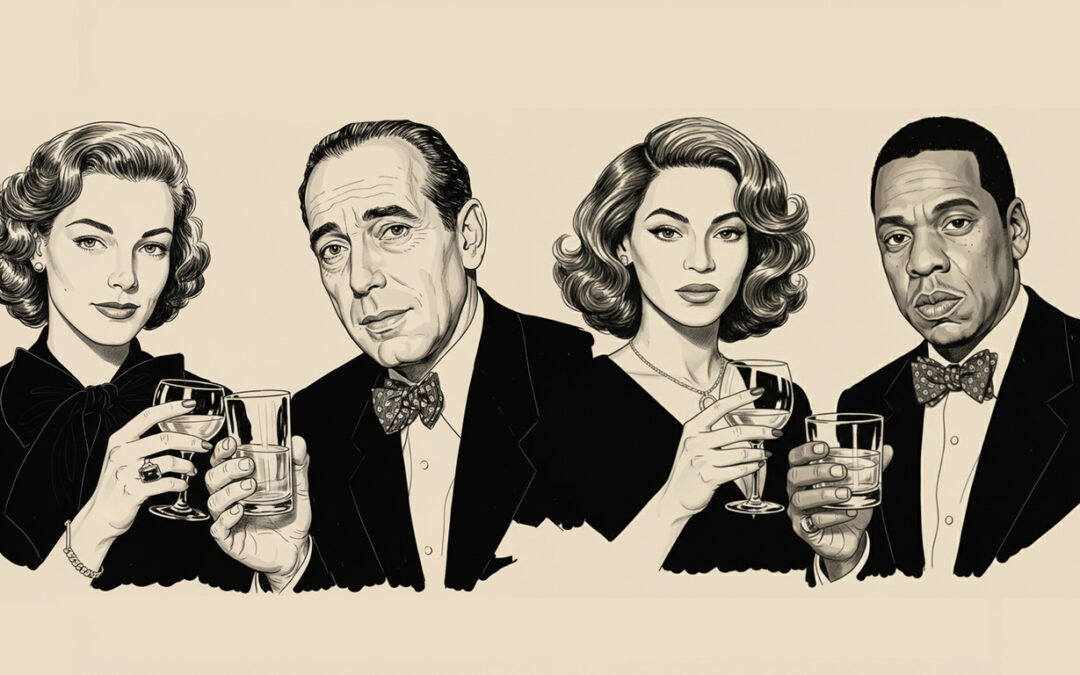
Humphrey Bogart and Lauren Bacall. Bacall was 19, stunning, one of Hollywood's most striking new stars. Bogart was 45, with a slightly stiff upper lip from a childhood injury and a face that could generously be called "characterful." Their chemistry was legendary. What did Bogart have? Confidence, dry wit, a fully formed worldview, and the unmistakable quality of a man who knew exactly who he was.
Paul Simon and Carrie Fisher. Fisher was one of the defining beauties of her generation; Simon was a slight, five-foot-three man who happened to write some of the most emotionally intelligent popular music of the 20th century. She was reportedly mad about him. His brain was the attraction.
Mick Jagger (in his prime relationships). By objective looksmaxing metrics, Jagger — prominent lips, unconventional features, extremely lean — would score inconsistently. And yet he has been with some of the most beautiful women in the world across six decades. Energy. Charisma. Talent. Presence.
John Lennon and Yoko Ono. Again — not a man who would rank highly on any facial metric scale. Ono was an internationally regarded avant-garde artist. She said she fell for his mind.
The pattern is consistent across history, across cultures, and across economic backgrounds: women are attracted to the full package. Confidence. Humour. Intelligence. Emotional availability. Ambition. Presence. These things don't just supplement physical appearance — they often eclipse it entirely.
The looksmaxing community will tell you this is cope. It isn't. It's the lived reality of millions of couples throughout human history.
So What Should You Actually Do?
If you're a young man who found your way here via a looksmaxing forum or YouTube channel, here's an honest alternative programme:
Get physically healthy — not for your canthal tilt, but for your energy, your mood, and your longevity. Lift weights. Eat real food. Sleep properly.
Get socially healthy — join things. Play sport. Take a class. Go to events. Talk to people in real life. This is where attraction actually gets built.
Get intellectually interesting — read things. Develop opinions. Have a project. Have something you care about. There is nothing more attractive than a person who is genuinely alive in their interests.
Get therapy if you need it — if you're spending hours a day worrying about your face, that is a treatable condition, not a logical response to reality. Talking to someone is not weakness. It's the highest-leverage thing you can do.
Log off the forums — not forever, not because the internet is bad, but because the looksmaxing community is specifically designed to make you feel worse about yourself so that you keep coming back. Recognise the mechanism. Step back.
The Bottom Line
You are not a collection of facial measurements. You are not a canthal tilt or a jaw angle or a hunter's eye. You are a person with a developing personality, a unique history, particular humour and intelligence and capacity for connection that no bone structure could replace.
The young men who do best in life — who have full relationships, genuine friendships, meaningful work and real self-respect — are almost never the ones who spent their formative years optimising their faces. They're the ones who spent those years building themselves.
That's what's actually worth maxing.
If you're struggling with body image, anxiety about appearance, or thoughts about self-harm, please consider talking to your doctor or a mental health professional. You can also contact the Crisis Text Line by texting HOME to 741741 (US/Canada) or the Samaritans on 116 123 (UK).