
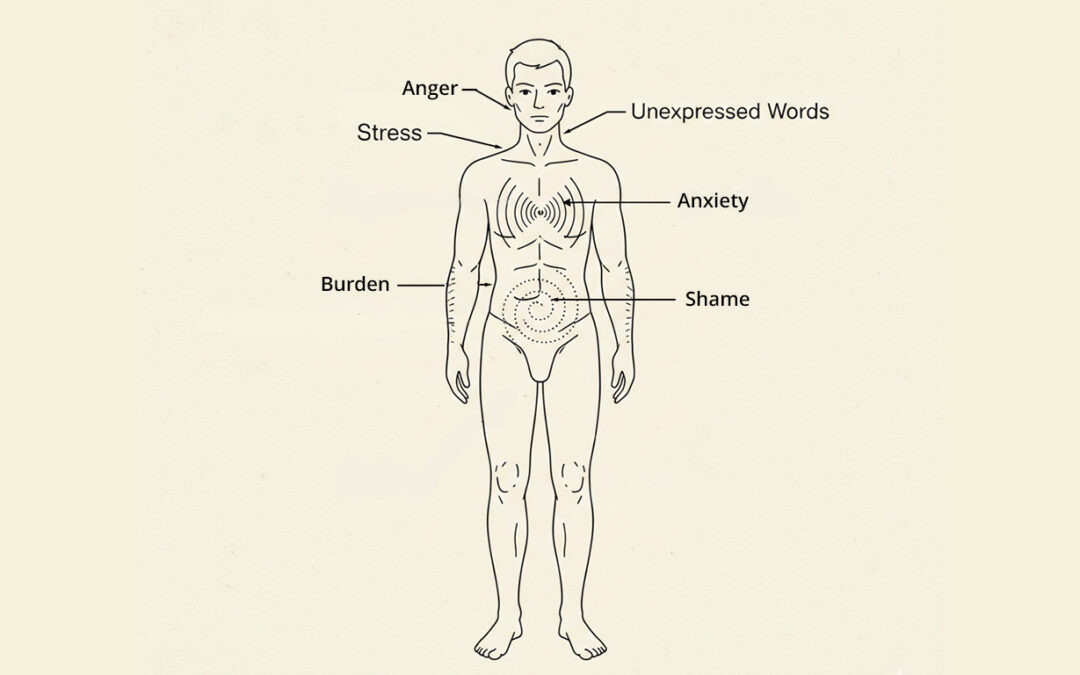
For most of my life, I thought emotions happened in my head. Turns out, I was missing about 90% of the picture.
Your body is talking to you all the time. The tension in your shoulders when your boss emails at 9 PM. The knot in your stomach before a difficult conversation. The clenched jaw when someone cuts you off in traffic. These aren't random physical reactions—they're your emotions speaking a language you might not have learned to understand yet.
As men, many of us were taught to "think through" our feelings rather than feel them. We were told to "man up," to use logic, to stay in control. But here's what nobody mentioned: ignoring your body's signals doesn't make you stronger. It just makes you disconnected from one of your most valuable sources of information.
The Map of Emotions in Your Body
Modern research in somatic psychology confirms what ancient traditions have known for centuries: different emotions tend to show up in predictable places in our bodies. Learning to recognize these patterns is like learning to read your own internal dashboard.
Anxiety Lives in Your Chest
That tightness across your ribcage. The shallow breathing. The feeling like there's a weight pressing down on your sternum. Anxiety often manifests as constriction in the chest and throat, sometimes accompanied by a racing heart or difficulty taking a full breath.
When you notice this sensation, your body is trying to tell you something about perceived threat or uncertainty. It's your nervous system preparing for danger—even if that "danger" is just an upcoming presentation or a text you haven't answered yet.
Anger Lives in Your Jaw
Pay attention the next time you're frustrated or angry. Chances are, you're clenching your jaw. Your teeth might be grinding. Your face feels hot. Your fists might ball up without you even realizing it.
Anger generates energy for action—it's mobilizing energy that wants to push back against something. That tension in your jaw and hands? It's literally your body preparing to fight, even when fighting isn't actually on the table. Many men carry chronic jaw tension from years of swallowing anger they didn't feel permitted to express.
Shame Lives in Your Gut
Shame is perhaps the most physically uncomfortable emotion we experience. It often shows up as a sinking feeling in your stomach, nausea, or a hollow sensation in your belly. Your shoulders might curl forward, your chest might cave in slightly. You might feel the urge to make yourself smaller or disappear.
This gut-level response to shame is deeply primal. When we feel shame, our body literally wants to hide. The digestive distress makes sense too—shame tells us we're unworthy of connection, which in evolutionary terms meant being cast out from the tribe. No wonder our guts respond so intensely.
Why This Matters for Your Health
When you ignore these bodily signals consistently, several things happen. First, the sensations intensify because your body keeps trying to get your attention. Second, you lose access to crucial information about your needs and boundaries. Third, chronic tension becomes your baseline, leading to headaches, back pain, digestive issues, and sleep problems.
I learned this the hard way. Years of pushing through stress without listening to my body led to chronic neck pain, insomnia, and eventually a wake-up call from my doctor about my blood pressure. Only when I started paying attention to what my body was trying to tell me did things begin to change.
Reading Your Own Signs
Start paying attention to your physical state throughout the day. You don't need to do anything about it yet—just notice.
Where do you feel stress first? Maybe it's tension between your shoulder blades. Perhaps your stomach gets upset. Some men notice their breathing gets shallow, or their hands get cold.
Where does sadness show up? Often in the throat and chest, sometimes as heaviness in the limbs or a feeling of fatigue.
Where does excitement live? Usually in the chest and belly, but as expansion rather than constriction.
The more you tune in, the earlier you'll catch these signals. Instead of realizing you're stressed only when you're snapping at people, you'll notice the early warning signs—the slight tightness, the shallow breath—and have a chance to respond before things escalate.
Body-Scan Meditation for Beginners
This practice is one of the most effective ways to develop somatic awareness. It's not about relaxation (though that's often a side effect). It's about learning to check in with your body and hear what it's telling you.
Duration: 10-15 minutes
What you need: A quiet space where you won't be interrupted
The Practice
Find a comfortable position. You can lie down on your back, sit in a chair with your feet flat on the floor, or sit cross-legged on the floor with cushions for support. The key is finding a position you can maintain without too much discomfort.
Close your eyes or lower your gaze. Take three deep breaths, letting each exhale be a little longer than the inhale.
Start with your feet. Bring your attention to your toes. Notice any sensations—tingling, warmth, coolness, tension, or maybe nothing at all. You're not trying to change anything, just observing. Spend 20-30 seconds here.
Move to your lower legs. Notice your ankles, shins, and calves. Are they relaxed or tense? Heavy or light? Again, just observe without judgment.
Shift to your knees and thighs. Scan for any sensations. Notice where your legs make contact with the surface beneath you.
Move into your hips and pelvis. This is an area where many men hold tension. Notice what's there without trying to fix it.
Bring attention to your lower back and abdomen. Your gut is a major center of emotional information. What sensations are present? Is your breathing moving into your belly, or is it shallow and restricted?
Scan your chest and upper back. Notice the rise and fall of your breath. Is your chest tight or open? Are your shoulders relaxed or hunched?
Move to your shoulders, arms, and hands. Shoulder tension is incredibly common. Notice if you're holding your shoulders up near your ears. Follow the sensation down through your arms to your fingertips.
Bring attention to your neck and throat. Notice any tightness or constriction. This is where unexpressed words often get stuck.
Scan your jaw, face, and scalp. Unclenching your jaw if it's tight. Notice your forehead, temples, the space around your eyes.
Take a moment for your whole body. See if you can hold awareness of your entire body at once, from feet to head. Just rest in this awareness for a minute or two.
When you're ready, slowly deepen your breath, gently move your fingers and toes, and gradually open your eyes.
What to Expect
The first few times you do this, your mind will wander. That's completely normal. When you notice you've drifted into thoughts, gently bring your attention back to the body part you were scanning. This isn't a failure—this IS the practice.
You might notice discomfort or emotions arising. Again, this is normal. You're learning to be present with whatever is true in your experience, rather than distracting yourself from it.
Some days you'll feel very in tune with your body. Other days it might feel like you're scanning a stranger's body. Both are fine. Consistency matters more than perfection.
Making This Part of Your Life
You don't need to become a meditation expert or spend hours in somatic therapy (though both may be valuable). Start small:
- Set a phone reminder to pause and notice your physical state three times a day
- Before making an important decision, check in with your body first
- When you notice strong emotions, ask yourself: "Where am I feeling this?"
- Practice the body scan once or twice a week, even if just for 5 minutes
The goal isn't to eliminate uncomfortable sensations or difficult emotions. It's to develop a relationship with your body where you're listening instead of ignoring, responding instead of reacting, and treating yourself with the same respect you'd offer a good friend.
Your body has been trying to communicate with you your whole life. Maybe it's time to finally learn the language.
What patterns have you noticed in your own body? Where do you tend to hold stress or difficult emotions? I'd love to hear about your experiences in the comments.