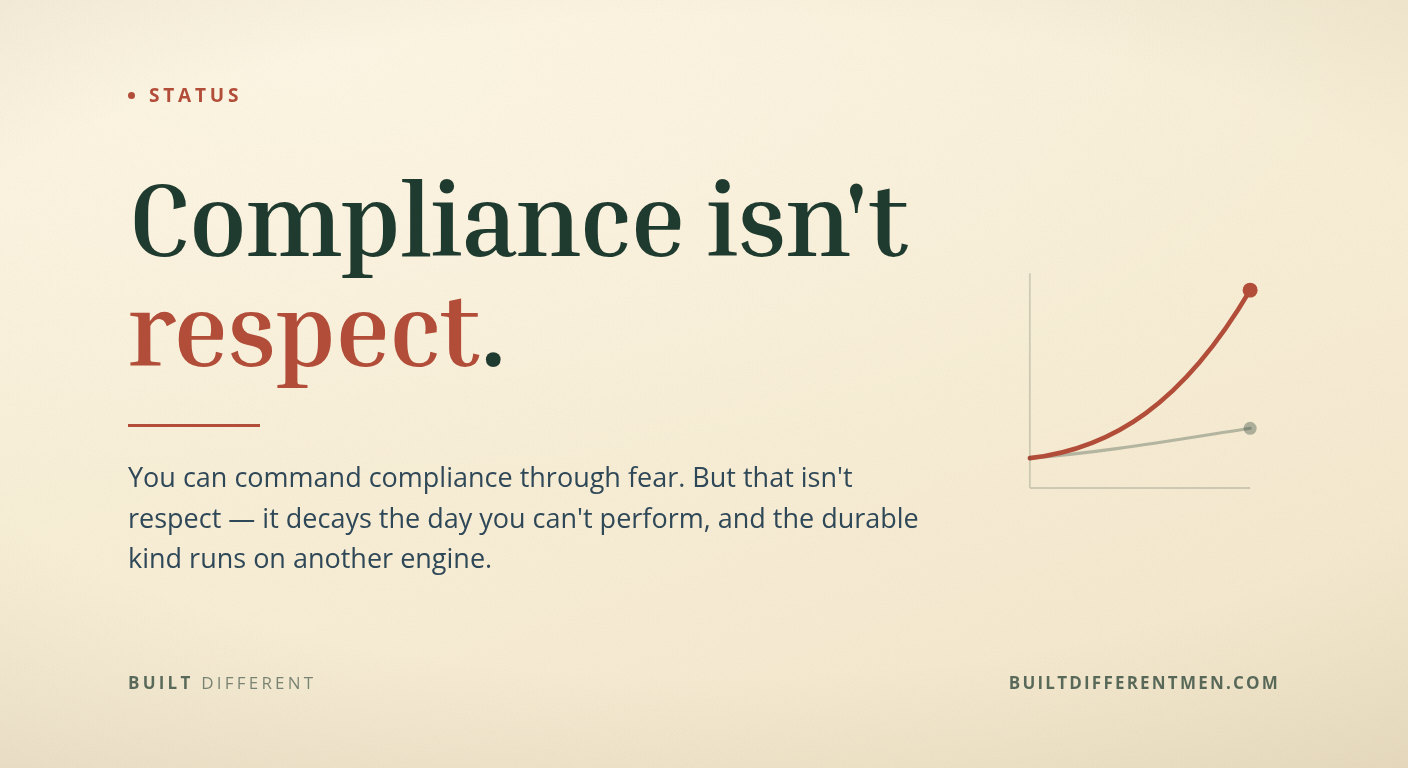
You can command compliance — that part's real, and it's what the internet is selling you. But compliance isn't respect, and the difference shows up the first day you can't keep performing. Respect that lasts runs on a different engine. Here's the one that's still working when you're fifty.
Start with the honest answer, because the search itself is half the trap.
You can't command respect the way the word makes it sound — the way it's sold to you, all posture and hard eye contact and never backing down. What you can command, with enough intimidation, is compliance: people doing what you want because they're calculating the cost of crossing you. That feels like respect from the inside. It produces the same surface — people listen, people go along, people don't push back. But it is a different thing wearing respect's clothes, and the gap between them is the whole subject of this piece.
There are two engines, and they look identical for a while
Researchers who study how humans actually sort out who ranks where have found that people rise in two distinct ways. The framework goes back to Henrich and Gil-White in 2001, and the sharpest test of it is a set of studies by Joey Cheng and colleagues, published in the Journal of Personality and Social Psychology in 2013. They named the two routes dominance and prestige.
Dominance is rank through fear. People defer because they're afraid of what happens if they don't. Prestige is rank through value. People defer because they want to be near what you offer — skill, knowledge, judgment, the chance to learn something. And here's the part that keeps this honest: the research does not say dominance fails. It says both routes genuinely work. Both get you real influence and real deference. So anyone promising that the intimidation game simply doesn't function is lying to you, and you'll know it, because you've watched it work on people.
The difference isn't whether they work. It's what they cost, how long they last, and what they leave behind.
Why commanded respect has an expiry date
Fear-based deference has one fatal property: it has to be maintained. Every day, in every interaction. The moment the threat weakens — the moment you're tired, sick, wrong about something, having a bad month, older than you were — the deference starts to slip, because the only thing holding it up was the fear, and the fear just dropped.
So the man running on dominance can never actually rest. He can't say "I don't know." He can't be visibly unsure. He can't lose a disagreement or admit a mistake, because every one of those cracks the performance that his whole standing rests on. That's exhausting in a way you don't feel at twenty-five and feel in your bones at forty-five. And it comes with a second bill: the people who complied out of fear were never loyal. They were waiting. They remember every time you made them small, and the day your power wobbles, they are not in your corner — some of them are actively helping it fall. The dominant man builds an empire of compliance and a graveyard of allies, and there's nobody in the graveyard who comes when the empire shakes. That full arc — impressive at twenty-five, exhausting at forty-five — is laid out in Dominance vs. Prestige: The Two Pathways to Status, which is the deep version of this whole argument.
Commanded respect, in other words, is a subscription. You pay for it every single day, and it cancels the day you miss a payment.
What actually earns the durable kind
Prestige runs the other way. It's not maintained; it accumulates. Every time you do good work, keep your word, or help someone get better, it stacks — and it keeps sitting there in your reputation, working while you sleep, not needing to be re-earned each morning. It's slower to build. It's also nearly impossible to lose overnight, because it was never propped up by a performance that could drop.
Which means the real answer to "how do I get men to respect me" isn't a posture. It's a handful of unglamorous things done consistently until they become who you are:
Get genuinely good at something. Not performatively good — actually good, the kind that holds up when it's tested. Competence is the base layer of durable respect, because people can feel the difference between a man who knows what he's doing and a man managing an image of it. It also changes how you carry yourself without your having to fake anything, which is the mechanism behind What Real Confidence Looks Like.
Keep your word — the small ones especially. Do what you said, when you said you would. It sounds too simple to matter. It's the opposite: the men whose yes reliably means yes become, over time, the men everyone wants in the room, precisely because almost nobody does it consistently. Reputation is built out of hundreds of tiny kept promises, and people register every one whether or not they mention it.
Give credit away. Real, specific, public credit. The man who hands it out generously is the one nobody resents and everyone wants to work with; the man who hoards it poisons his own ground and then wonders where the loyalty went. Giving credit doesn't shrink you. It does the opposite.
Be the same man in every room. One person to your boss and another to the intern, one on your good days and another on your bad — that man gets found out, and the finding-out costs him everything at once. Consistency, not perfection, is what earns the kind of trust no amount of intimidation can manufacture.
Stop keeping score in the room. When you walk into a meeting, notice whether your first instinct is to work out who's above and below you, or to make the thing actually better. When you meet another man, notice whether you're sizing him up as a threat or as someone you could build with. Every one of those small choices is a vote for one engine or the other, and over a decade the votes add up to a man people either obey or respect.
The reason the loud version is everywhere
If prestige is the better engine, why is your whole feed selling dominance? Because dominance is teachable in a weekend and endlessly monetizable. A man building real respect doesn't need a course — he needs to go get good at something and treat people well over years, and there's no upsell on that. A man chasing the commanded kind is a customer forever: the posture course, the frame-control seminar, the wardrobe, the next program when the last one didn't take. An entire industry has a reason to keep telling you respect is something you seize by force. Not because it lasts. Because the seizing is what sells. The same machinery is pulled apart in Why the "Alpha/Beta" Binary Keeps You Anxious (Not Confident).
You can opt out of being that customer. Most men never realize opting out is on the menu.
The respect you can command collapses the day you can't perform. The respect you earn is still standing when you're seventy and can't intimidate anyone. If you're going to spend years building either, build the one that's still paying you at the end.
Practice prompt: Think of a man you genuinely respect — not the most intimidating one you can name, the one you'd actually go to. Why him? Write down the real reason. Almost certainly it's something he built or something he reliably does, not something he projects. Now ask which one you've been trying to build in yourself.
Related essays
- Dominance vs. Prestige: The Two Pathways to Status — the deep version: how the two engines diverge over a lifetime.
- What Actually Makes a Man High Status — the science of status, and what people actually confer it for.
- What Real Confidence Looks Like — why competence, not posture, is the base layer.
- Is the Alpha Male Real? — the science the dominance pitch is built on, debunked by its own author.
- The Strength Paradox — why the invulnerable performance is the brittle one.
Filed under: Status, Confidence, The Alpha Myth