
There's a guy named L. David Mech. Most men who lecture you about being an alpha have never heard of him.
That's a problem. Because Mech is the biologist who put the alpha wolf into popular culture in the first place. His 1970 book, The Wolf: The Ecology and Behavior of an Endangered Species, is the source of nearly every "alpha male" speech you've ever heard at a gym, on a podcast, or from a guy who thinks reading three Jordan Peterson clips makes him an evolutionary psychologist.
And Mech has spent the last thirty-plus years trying to take it back.
He's written articles correcting it. He's gone on record saying the model is wrong. He's literally asked his own publisher to stop printing the book. He'll tell anyone who asks that the alpha framework doesn't describe how wolves actually live.
Nobody listens.
The myth has outrun the science. The marketing has outrun the man who started it. And an entire generation of young men is being told to organize their lives around a concept its own author has been begging the public to retire.
Let's talk about why.
The Captive Wolves
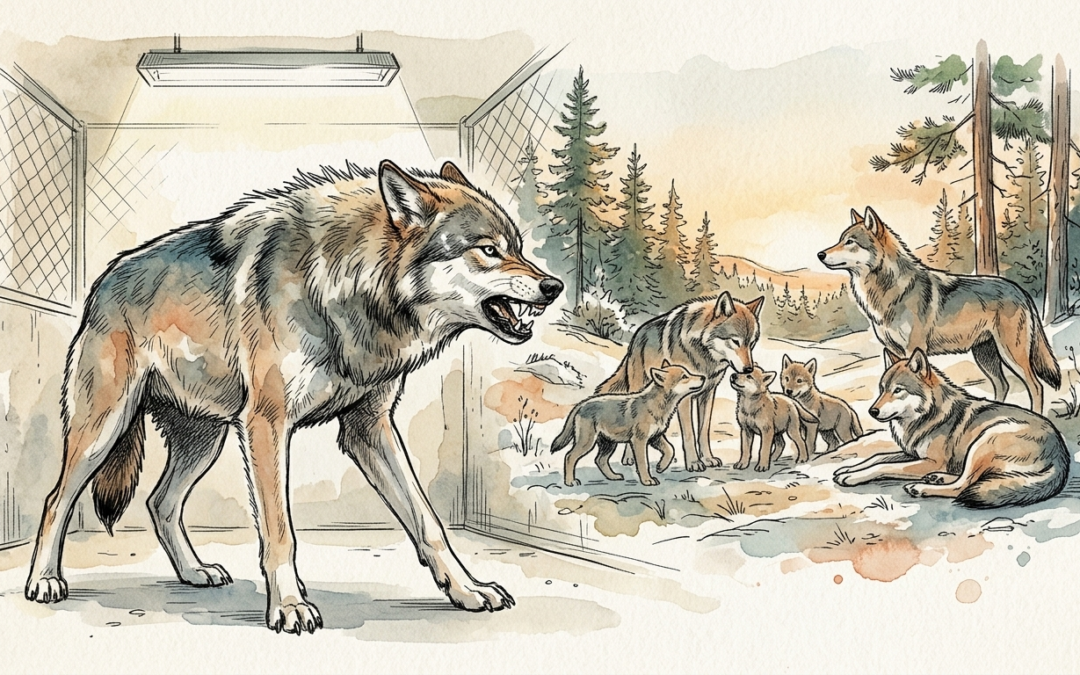
The alpha wolf concept didn't start with Mech. It started with a Swiss researcher named Rudolph Schenkel in 1947. Schenkel watched wolves in a zoo in Basel and described what he saw: a chaotic pecking order, brutal competition, an aggressive male dominating everyone else through violence and threat.
Sounds dramatic. Sounds compelling. Sounds like exactly the kind of "natural law" you could build a worldview on.
There's just one problem. Schenkel was watching wolves in a cage.
Not a family. Not a pack. A random collection of unrelated adults shoved into the same enclosure with no escape. Forced into proximity. Forced into competition for food, space, and mates they hadn't chosen. He was studying the dynamics of a prison and calling it the dynamics of a species.
If you put twenty random adult humans in a fenced yard and watched them for a year, you'd see things too. Bullying. Coalitions. Submission and dominance. Someone would emerge as the loudest, the most aggressive, the most willing to take what they wanted. You'd be observing the same thing Schenkel observed.
You wouldn't be observing human nature. You'd be observing what humans do under unnatural confinement.
That's the foundation of the alpha model. A study of captive animals doing what captive animals do, mistaken for a description of how wolves—or humans—are designed to live.
What Mech Actually Found
Mech popularized Schenkel's idea in his 1970 book and then spent the rest of his career out in the wild watching real wolves. Not zoo wolves. Not enclosed wolves. Wolves in their actual habitat, in their actual social groups, doing what they actually do.
He saw something completely different.
Wolf packs in the wild are not gangs of unrelated males fighting for dominance. They're families. A breeding pair—mom and dad—and their offspring from the last few years. The "alpha male" is just the dad. The "alpha female" is just the mom. The "betas" are their kids.
There's no fight to become alpha. You become alpha by growing up, finding a mate, and starting your own family. That's the whole mechanism. It's not a tournament. It's biology.
The "submissive" behaviors Schenkel saw in the zoo? In the wild, those are mostly young wolves deferring to their parents. Which is what kids do. It's not a power struggle. It's a family structure.
Mech wrote a paper in 1999 titled Alpha Status, Dominance, and Division of Labor in Wolf Packs. He laid it out plainly: the term "alpha" is misleading. It implies a competition that doesn't happen. Wild wolves don't fight their way to the top. They form pair bonds, raise pups, hunt together, and eventually the pups grow up and leave to start their own packs.
Wolf packs aren't fight clubs. They're families.
The Correction Nobody Wanted
Here's what's wild. Mech didn't quietly update a footnote. He went out of his way to correct the record.
He published the correction. He gave interviews. He recorded a YouTube video specifically titled to address the misconception. He requested that his original book stop being printed because the science in it was outdated. Imagine the integrity that takes—asking your own publisher to pull a book that still sells, because you no longer believe what's in it.
And it didn't matter.
The alpha concept had already escaped the lab. It was loose in the culture. It was being repackaged by self-help authors, dating coaches, business gurus, men's-rights forums, and eventually an entire industry of online creators selling "high-value man" courses to lonely young men who needed someone to tell them why life felt hard.
A scientific correction can't compete with a profitable myth.
The alpha framework solved a problem the truth couldn't. It gave men a clear hierarchy, a clear goal, a clear villain (the betas), and a clear path (dominate). It made status anxiety feel like strategy. It made aggression feel like authenticity. It made loneliness feel like leadership.
The truth Mech offered was harder to sell. Wolves are families. Status is complicated. There's no hierarchy to climb because the hierarchy doesn't exist the way you think. Try fitting that on a YouTube thumbnail.
So the myth kept going. And going. Decades after the science was corrected. Decades after the man who started it begged people to stop.
It's still going right now, on the phone in your pocket, in feeds full of guys flexing in front of rented Lamborghinis, telling you to be the wolf.
The wolf they're describing doesn't exist.
What This Means For You
You can dismiss this as science trivia. Cool wolf fact, who cares. But the alpha framework isn't just a wrong picture of wolves. It's the load-bearing wall of an entire ideology being sold to young men. Pull that wall, the rest of the structure shakes.
If wolf packs aren't dominance hierarchies, the "natural order" argument collapses. There's no nature to appeal to. The whole "this is just how males are wired" pitch is built on captive zoo behavior misread as biology.
If wolves cooperate to hunt, raise young, share food, and protect their family, then the lone-wolf ideal is also a lie. Real lone wolves aren't sigma males. They're usually sick, injured, exiled, or transitioning between packs. Most of them don't survive long. Solitude isn't strength in wolves. It's a death sentence.
If the alpha pair are just parents, then "becoming alpha" doesn't mean dominating other men. It means being someone capable of raising and protecting people who depend on you. That's not aggression. That's responsibility.
Notice how the actual biology points in the opposite direction of the marketing.
The alpha you've been sold is aggressive, dominant, competitive, isolated, and anti-social. The actual alpha—if we're going to keep using the word at all—is paternal, cooperative, protective, deeply embedded in family, and doing the unglamorous work of keeping a group alive.
One of these is a TikTok aesthetic. The other is a description of how mammals survive.
The Human Hierarchy Question
Here's where it gets uncomfortable for the alpha-pilled crowd.
Human social structures are not wolf packs. We're a different species with different evolutionary pressures. But to the extent we can learn anything from how cooperative mammals organize themselves, the lesson points away from dominance, not toward it.
Anthropologists who've studied small-scale human societies—the kinds of groups our ancestors lived in for the vast majority of human history—keep finding the same thing. Hunter-gatherer bands tend to be aggressively egalitarian. They have leaders, but leadership is situational. The best tracker leads the hunt. The best mediator handles the conflict. The best storyteller runs the fire. Authority shifts based on context.
Anyone who tries to dominate the group through force or arrogance gets corrected, often brutally. Mockery. Exclusion. In some societies, exile. The would-be alpha doesn't become king. He becomes a problem the group manages.
This is the social architecture humans actually evolved in. Not zoo wolves. Not warlord chiefdoms. Cooperative bands of relatives and chosen companions where dominance was a liability and contribution was the currency.
Researchers have a name for what actually produces durable status in human groups. They call it prestige, and they distinguish it carefully from dominance.
Dominance is status through fear. People defer because they're afraid of you. It works—until your power slips, and then everyone you were dominating remembers exactly how they felt.
Prestige is status through skill, knowledge, and contribution. People defer because they want to learn from you, work with you, be near what you're building. It compounds over time. It survives weakness. It survives age. It survives setbacks.
The alpha model promises dominance and calls it strength. The science—across wolves, across humans, across most cooperative mammals—keeps pointing at prestige instead.
You don't get respect by being the most threatening person in the room. You get it by being the most useful one.
Why The Myth Won't Die
If the alpha concept was retracted decades ago, why does it still own the algorithm?
Because it's profitable.
The alpha framework is a perfect product. It identifies a real pain—status anxiety, loneliness, uncertainty about how to be a man—and offers a simple, masculine-coded solution that requires you to keep buying. Courses. Coaching. Supplements. Programs. The whole industry depends on you believing the hierarchy is real and that you're losing in it.
A young man who believes wolves are families and that prestige beats dominance doesn't need to buy the course on how to dominate. He can just go become competent at something and treat people well. There's no upsell on that.
A young man who believes he's locked in a brutal hierarchical competition for scarce status will keep buying. Forever. Because the win condition the framework promises—reaching the top—doesn't exist. There's always someone above you. There's always someone coming up. The anxiety is the engine.
This is why the correction doesn't land. It's not that people haven't heard it. It's that an enormous amount of money depends on you not internalizing it. The myth isn't surviving by accident. It's being maintained on purpose.
That's worth knowing. The next time you scroll past someone telling you to "be the alpha," ask yourself what they're selling. There's almost always something. The framework isn't free advice. It's the warm-up act for a transaction.
What To Build Instead
So what do you do with this?
Not nothing. The fact that the alpha model is wrong doesn't mean status doesn't exist, that hierarchies don't form, that some men aren't more respected than others. They are. The question is what kind of respect, earned how, and at what cost.
You can spend the next ten years performing dominance. Posturing. Refusing to back down from anything. Treating every conversation as a status negotiation. Cultivating a face you can never let slip. You'll burn out. You'll be lonely. You'll have surface-level allies and zero real friends. And the day your performance slips—through illness, age, setback, anything—the people you dominated will remember exactly how it felt.
Or you can build the other thing.
Get good at something real. Become the person people call when they need help. Show up for your family. Keep your word. Tell the truth even when it costs you. Take care of the people in your life like a wolf actually takes care of his pack—by hunting for them, defending them, raising them, not by snarling at them.
That's not soft. That's not beta. That's not whatever insult is currently in fashion. That's what every cooperative mammal that's ever survived has done. It's the actual evolutionary blueprint, not the cosplay version.
Mech tried to give us the real one. He's still trying. He's in his eighties and still publishing, still correcting the record, still pointing at what wolves actually do.
The least you can do is listen.
You're not a wolf. But the men selling you wolf metaphors aren't selling you wolves either. They're selling you zoo animals in cages, and telling you that the way those animals behave under captivity is who you really are underneath.
It isn't.
Underneath, you're built for something more like a family than a fight club. You always were.
Now build like it.
---
Practice prompt: Think of the most respected man you actually know personally—not a celebrity, not an influencer, someone whose respect you'd actually want. Now ask: did he get there by dominating people? Or did he get there by being good at something and reliable to the people around him? What does that tell you about the model they are trying to sell you versus the one that actually works?