
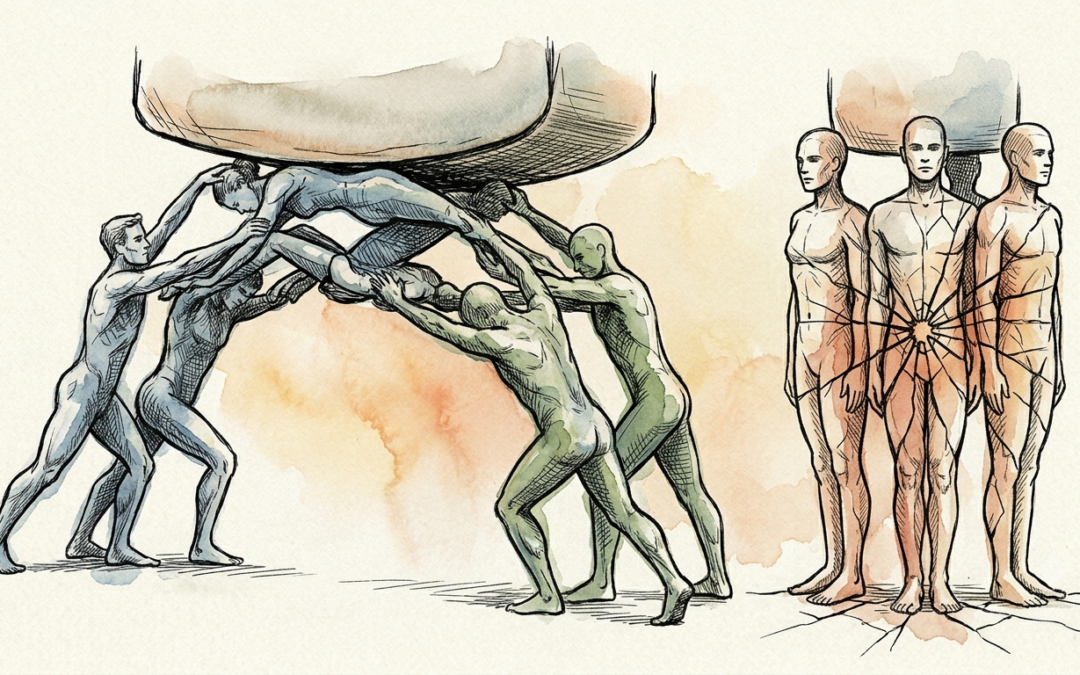
The pitch is simple and it lands hard: be unbreakable. Don't flinch. Don't bend. Don't let anything touch you deeply enough to move you off your position. The man who can't be rattled, who absorbs everything without showing strain, who needs nothing from no one — that's the template. That's what strength looks like, or so you've been told.
You can see why it sells. It's a clean image. It has edges. It photographs well on a podcast set between a $3,000 microphone and a framed quote about wolves. The promise is ironclad: build yourself into something hard enough, and life can't break you.
Here's what the pitch leaves out. Invulnerability doesn't prevent breaking. It just makes breaking catastrophic when it finally comes.
The Glass Problem
There's a reason engineers don't build bridges out of glass.
Glass is rigid. It doesn't flex under load. It looks flawless, holds its shape, seems impervious — right up until the stress exceeds its tolerance, and then it doesn't bend, it shatters. The same property that makes it appear strong is the property that makes it fail completely.
Steel behaves differently. Steel bends. Under load, it deforms slightly, distributes stress across its length, absorbs impact. That flexibility isn't a flaw in the material. It's the engineering feature that makes steel useful for structures that have to survive the world.
This is not a metaphor about feelings. It's a description of how load-bearing systems actually work.
When you build your identity around being unaffected — by difficulty, by loss, by doubt, by the legitimate weight of other people's lives — you're building in glass. You look solid. You might go years, even decades, without visible strain. And then something comes that exceeds your tolerance, and there's no give. There's no absorption. There's nowhere for the load to go.
It just breaks. Often all at once.
What Brittleness Actually Costs
The men who end up in crisis — not the slow, manageable kind, but the sudden collapse kind — often look, from the outside, like they were fine. They projected competence. They handled things. They didn't ask for help. Then a death, a divorce, a job that ended, a body that stopped cooperating — something that couldn't be controlled arrived, and the structure that was never built to flex had nothing left to offer.
The suicide statistics are a data set that doesn't get talked about in spaces that sell invulnerability. Middle-aged men. Often no warning. Often described by people who knew them as steady, capable, not the type to struggle. That description is the warning, if you know how to read it.
Brittleness looks like strength right up until the moment it doesn't.
What it costs you before that moment is subtler and harder to measure. It costs you depth. You can't actually know or be known by another person if you're managing their perception of you at every moment. The relationships stay functional — polite, useful, sometimes even warm — but they don't go anywhere. They can't. You've built a wall and called it a personality.
It costs you information. When you're committed to projecting competence, you can't admit when you don't know something. You can't ask for input. You can't get honest feedback. You make decisions in the dark and call it self-reliance.
It costs you resilience — the actual kind, not the performance of it. Resilience isn't the ability to be unaffected. Resilience is the capacity to be affected and recover. To take the hit, acknowledge it, stay connected to people and purpose, and come through without complete structural failure. You can't build that without flexibility.
Why the Pitch Works
The invulnerability model isn't selling you nonsense from nothing. It's taking something real and warping it into something profitable.
There's a legitimate problem underneath it. You've probably been in rooms — workplaces, families, friendships — where showing struggle was punished. Where admitting uncertainty was used against you. Where the first person to stop performing got left behind. Those experiences are real. The instinct to protect yourself by showing nothing is a rational response to environments where vulnerability was weaponized.
The grift isn't in identifying the problem. It's in the solution.
The manosphere, the invulnerability coaching industry, the "high-value man" content that has flooded every algorithm — it takes a real wound (the risk of being exploited when you're honest) and offers an overcorrection (be exploitable by nothing, ever). The overcorrection sells because it feels like control. You get to stop managing a complicated situation and start following a rule: show nothing.
But a rule that solves one problem by creating a worse one isn't wisdom. It's just a different trap with better marketing.
The Actual Definition of Strong
Here's what the research on men who handle serious difficulty well actually shows, when you strip away the branding: they're not unaffected. They feel what's happening. They acknowledge it — to themselves, and to people they trust. They maintain connection during difficulty instead of withdrawing until they've "handled it." They ask for help before they're drowning.
They bend. And because they bend, they don't break.
The man who won't tell anyone he's scared before a medical diagnosis — who handles it alone, who projects normalcy, who receives the news in isolation — isn't demonstrating strength. He's demonstrating that he's never built the infrastructure that makes genuine strength possible. He's doing it alone because he doesn't have the network that would make doing it together an option. That network doesn't appear when you need it if you've spent years signaling that you don't need anyone.
Compare that to the man who, facing the same situation, tells the people he trusts what's happening. Who admits he's scared. Who accepts logistical and emotional support. Who stays connected throughout instead of disappearing into the performance of coping. He's not weak. He's load-bearing something real without the structure failing.
Which one is stronger? The one who appears unbroken until he isn't, or the one who bends and holds?
The Selective Transparency Problem
Understanding that flexibility is structural doesn't mean collapsing all your walls. Not every situation is safe for honesty. Not every person in your life has earned access to what you're actually dealing with. There's a difference between being vulnerable and being indiscriminate.
The skill isn't just in being honest about struggle. It's in knowing who has demonstrated they can hold it — who will respond with care rather than judgment, who has shown over time that your disclosure will strengthen the relationship rather than be used as ammunition, who is building toward the same kind of depth you're trying to build.
That's not armor. That's judgment. And it matters.
The reason a lot of men get this wrong in one direction or the other — either bricked up completely or oversharing in ways that damage rather than deepen — is that they never learned to distinguish between the two. Either you show nothing, ever, to anyone, or the dam breaks and everything comes out at once in a situation where it wasn't invited and the other person wasn't equipped for it.
Neither of those is flexibility. The first is rigidity. The second is what happens when rigidity finally fails catastrophically.
Actual flexibility means you have a range. You can hold yourself together when the situation requires it. You can also open up when the situation and the person warrant it. You have the judgment to know the difference, and you've done the slow work of building relationships where the second option is actually available to you.
What You Have to Build
If you've been operating from the invulnerability model for long enough, the alternative doesn't just feel difficult — it feels like freefall. You've built your whole sense of self around not needing the structure that other people lean on. Changing that isn't a mindset shift. It's construction.
It starts small, because trust is built incrementally. You don't prove a foundation can carry load by immediately stacking the whole building on it. You test it. You have a conversation that's slightly more honest than your default. You ask for help with something modest. You admit uncertainty in a low-stakes situation. You watch what happens.
What you'll find, most of the time, is that the catastrophe you were bracing for doesn't arrive. The person across from you doesn't lose respect. They don't exploit the opening. More often, they respond with respect — because you've trusted them with something real, and that's actually rare enough to mean something.
Over time, this is how you build the network that makes genuine resilience possible. Not by performing strength until you don't have to anymore. By doing the slower work of constructing relationships where you can be honest about what you're carrying, and where the other person can be honest with you in return.
That's not a weakness in the structure. That's what makes it load-bearing.
The thing you were sold promises to protect you from being hurt by making you impervious to impact.
What it actually delivers is a structure with no give — one that looks solid until the load exceeds its tolerance, and then fails all at once, alone, without the support system that wasn't built because it wasn't supposed to be needed.
Real strength isn't the absence of strain. It's the capacity to carry load, flex under pressure, maintain connection and function through difficulty, and come through without catastrophic failure.
You don't build that by becoming harder.
You build it by becoming more structurally sound.
Practice prompt: Think about the last time you were dealing with something difficult and someone asked how you were doing. Replay your answer. Now ask: was that honest — or was it a version of yourself you decided they were allowed to see? Not whether you should have said more. Just whether there was a gap between what you said and what was actually happening. Notice the gap. That gap has a cost, and it's worth knowing what you're paying.