
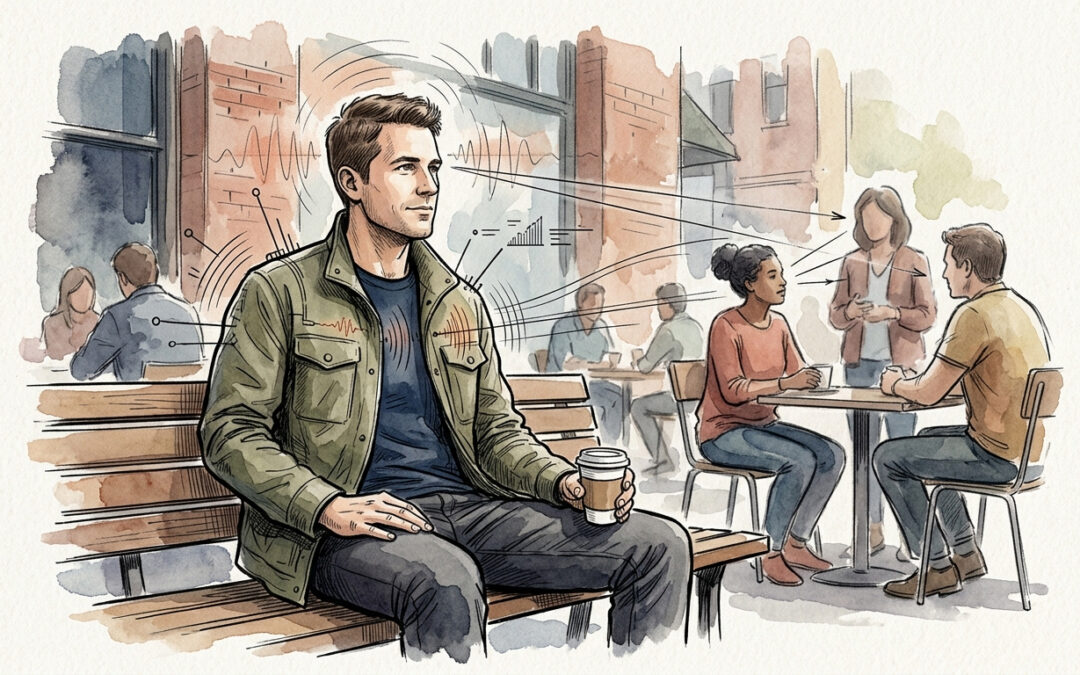
Somewhere along the way you got handed a definition of strength that required you to be a little bit dead.
Not literally. Just numb enough. Calibrated to miss things. Trained to ignore the room. The slight shift in someone's voice. The moment a friend stopped meeting your eyes. The silence after a joke that didn't land the way you thought it would. You learned to call this discipline. You learned to call the guys who noticed those things soft. You learned that picking up signals was a girl thing, an HR thing, a therapy thing. Not a man thing.
That training had a logic. It looked like efficiency. If you didn't pick up on subtleties, you didn't have to respond to them. If you didn't notice the discomfort in the room, you didn't have to slow down for it. If you didn't feel your way through a conversation, you could just execute the script and move on. Less drag. More output. That was the pitch.
What it actually delivered was a deficit in social intelligence so wide that it now shows up in your job, your friendships, your relationships, and your capacity to lead anything other than a group chat. The guys with the dialed-down sensors aren't winning. They're just operating with bad data and calling it strength.
Sensitivity isn't a personality trait you got stuck with. It's a sensing apparatus you were taught to turn off. And the men who learn to turn it back on, who can read a room, register what someone actually said versus what they said with their mouth, notice when something is off and respond to it, those are the men who get described as competent. Trustworthy. Easy to work with. Easy to love.
This is the reframe. Sensitivity is equipment. Attentiveness is skill. And the men who lack both aren't tougher than you. They're just navigating blind.
What You Were Sold
The pitch was clean. Real men don't get their feelings hurt. Real men don't pick up on emotional undercurrents. They cut through them. Real men say what they mean, take what they want, and don't waste energy on the soft stuff. The soft stuff is for people who can't handle the hard stuff.
This sells because it solves a real problem badly. The real problem is that being sensitive in a culture that mocks sensitivity is genuinely painful. You get teased. You get dismissed. You get told to toughen up. So the pitch offers you a way out. Just stop being sensitive. Numb it down. Treat your own perceptiveness as a defect to be fixed.
The grift pitching this is everywhere. It's the podcast guy explaining that high-value men don't care what women think. It's the dating coach selling "outcome independence," which is code for stop noticing how your behavior lands. It's the influencer telling you emotions are weakness and that the real move is stoic detachment. They've taken Marcus Aurelius, scraped off the actual philosophy, and sold you the leftovers as a personality.
And the upsell is always the same. Buy the course. Join the brotherhood. Subscribe to the channel. Learn the frame. Pay another guy to teach you how to feel less so you can perform more.
Your sensitivity is the product. The numbness is the upsell.
The Cost of Running Without Sensors
A car with broken sensors isn't tougher than a car with working ones. It's just more likely to crash.
Same with you. When you've trained yourself not to register what's happening in the room, you don't become more decisive. You become less accurate. You miss the moment your partner stopped trusting you. You miss the friend who was trying to tell you he was struggling. You miss the colleague who needed five seconds of acknowledgment and would have walked through a wall for you afterwards. You miss the kid who asked for you with his eyes when you weren't looking up.
Then later, sometimes years later, you're standing in the wreckage wondering what happened. The marriage that ended. The friend who pulled away. The team that quietly stopped bringing you their best work. The kid who stopped trying. You weren't blindsided. You just had your sensors off.
This is the numbness tax, paid in relationships instead of money. You didn't save anything by not noticing. You just deferred the bill, and the bill compounds.
The cost shows up in your career too. The men who get promoted into leadership aren't the ones who project the most dominance. They're the ones who can read the room. They know when the team needs reassurance versus pressure. They sense the disagreement no one's saying out loud. They can tell when a junior person is about to burn out and intervene before they do. That's not soft. That's load-bearing. The leader without those sensors keeps making decisions based on incomplete data and wondering why his people are leaving.
The cost shows up in dating too. The guys who do well aren't the ones running scripts. They're the ones who can actually tell the difference between someone being polite and someone being interested, between someone being flirty and someone being uncomfortable, between someone wanting space and someone wanting reassurance. The script-runners get rejected and call it bad luck. The attentive guys build something.
You don't get a discount for being unable to read people. You just pay more, later, in worse currency.
Reading the Room Is a Skill, Not a Vibe
Here's where it helps to be concrete. Social intelligence isn't a mystical capacity that some people have and others don't. It's a set of learnable inputs and a habit of using them.
You're tracking tone, not just the words but how they're being delivered. You're tracking body language: the leaning in versus the leaning back, the open posture versus the arms crossed. You're tracking what's not being said. The topics that got changed. The question that didn't get answered. The silence that came after a particular comment. You're tracking patterns. This person usually responds within an hour and now it's been two days. You're tracking your own reactions. Your gut said something was off in that conversation, and that's data, not paranoia.
None of this is mind-reading. It's just paying attention. You already do this when you're driving. You read the other drivers, the road, the conditions, the signals. You don't call yourself anxious or oversensitive for noticing the truck merging into your lane. You just call yourself a competent driver.
Social intelligence is the same skill, applied to people. The men who claim they don't have it usually do. They just don't use it, because they've been told that using it makes them weak.
It doesn't. It makes them functional.
And the skill compounds. The more attention you pay, the more accurate your reads become. You start recognizing patterns. You start noticing when someone's defending themselves versus when they're genuinely disagreeing. You start picking up on when a conflict is about the thing being argued versus about something underneath that hasn't been named yet. You start being able to defuse situations before they escalate, because you saw them coming.
This is what people mean when they call someone wise. It's not that the wise guy has access to special information. He just has his sensors on. He's been letting himself notice for so long that the noticing has become fluent.
Why "Sensitive" Got Coded as Weak
It's worth asking why this trait got marked down for men specifically. Because it didn't have to be this way, and the reasons are mostly bad.
Part of it is a leftover from a model of masculinity that worked, sort of, in a world that doesn't exist anymore. When most men did physical labour, when the role was to provide protection and resources through force or endurance, fine-grained social sensing wasn't the load-bearing skill. Strength was. Stoicism was useful armour against a world that was, for many men, physically dangerous.
But that world is largely gone. The work most men do now isn't physical. It requires communication, collaboration, reading people, building trust over time. The skills that get you promoted, that build durable relationships, that make you someone others want to be around, those are precisely the skills the old model told you to ignore. You're using software that was last updated four generations ago, and wondering why it keeps crashing.
The other reason sensitivity got coded as weakness is that an industry profits from telling you so. The manosphere, and the broader self-help economy that orbits it, needs you to believe that your perceptiveness, your capacity for empathy, your interest in being attentive, are bugs to be patched. Because if you accepted that they were features, you wouldn't need to buy anything. You wouldn't need the course on how to be stoic. You wouldn't need the seminar on dread game. You wouldn't need the influencer telling you that high-value men don't care.
Your sensitivity threatens their business model. So they reframe it as a defect and sell you the cure.
This isn't conspiracy. It's economics. A man at peace with his own attentiveness is not a paying customer.
What Care Actually Looks Like
The confusion that traps a lot of men here is between authentic attentiveness and the performance of it. They look at the "nice guy" who got rejected and conclude that empathy doesn't work. That women, or friends, or colleagues, secretly prefer indifference. That the way to win is to stop caring and project distance.
But the nice guy didn't get rejected because he was attentive. He got rejected because his attentiveness was transactional. A series of deposits intended to be withdrawn later, with interest, in the form of attraction or loyalty or sex. When the withdrawal didn't come, the niceness curdled into resentment, and everyone could feel it. The mask slipped.
That's not sensitivity. That's a strategy wearing sensitivity's clothes. And people can tell.
Actual care is unconditional. You're attentive because you're attentive. Because that's how you relate to people, not because you're storing up credit. You notice your partner is having a hard week because you're paying attention to her, not because you're hoping the attention buys you something later. You ask your friend the second question, the one that gets past "how are you," because you actually want to know, not because you're performing depth.
This is the difference. And it's the difference between connections that hold and connections that collapse the moment the transaction breaks down.
Authentic attentiveness is attractive because it's rare and because it signals capacity. It tells the other person: I can read you. I can adjust. I can be present with what's actually happening rather than what I planned to say. That's not weakness. That's the single most valuable thing you can offer another human being. People know it when they feel it. And they spend their lives looking for it.
The Trade You're Actually Making
It would be dishonest to pretend that turning your sensors back on costs nothing. It does. You notice more, which means you feel more. You pick up on tension in the room, which means you have to decide what to do about it. You register your friend's distress, which means you can't go home and forget about it. You become harder to lie to, including by yourself. That's a load.
The trade is real. The numbness model was offering you a kind of peace. The peace of a man with the volume turned down. You're trading that for accuracy. For the ability to actually navigate the world you live in instead of one you've sanded smooth.
It's worth it. But it isn't free, and pretending otherwise would be its own kind of grift.
What you get in exchange is competence in the only domain that matters. You become someone others can rely on. You become a better partner, a better friend, a better colleague, a better father, a better son. You become someone whose presence in a room makes the room work better. You become the guy people call when something hard is happening, because they know you'll actually be there. Not just physically. With all your sensors on.
That's not soft. That's the most useful version of you available.
The Build
You weren't born numb. You were trained into it. Which means you can be trained out of it.
It starts small. You notice when someone shifts in their seat, and you let yourself wonder why. You notice when your own gut flagged something in a conversation, and instead of overriding it, you stay with it for a beat. You notice when a friend says "I'm fine" in a tone that doesn't match the words, and you ask one more question. You notice when your sibling is quieter than usual at dinner. You notice when your partner mentions something three times in a week. You let the noticing land.
Then you act on it. Not in a big performance. Just by adjusting. Asking the second question. Holding the silence instead of filling it. Sitting next to someone without needing to fix them. Calling the friend back. Saying the thing you noticed out loud, gently, so the other person knows they were seen.
This is the work. It's not glamorous and there's no course for it and no one is going to give you a certificate. But it's how you build a life full of people who actually know you and who you actually know back.
Sensitivity isn't a liability. It's the most underused tool in your kit. You were told to throw it out. You don't have to.
Pick it up. Use it. Build like someone who has all his sensors on.
Practice prompt: Think about the last conversation you had where, somewhere in the middle, your gut registered that something was off. A flicker. A shift. A beat that didn't land. You probably overrode it and kept going. Replay the moment. What did you notice and then dismiss? What might have happened if you'd let yourself name it, even quietly, even just to yourself? You don't need to do anything with the answer. The noticing is the practice.