
BEFORE WE START — A QUESTION:
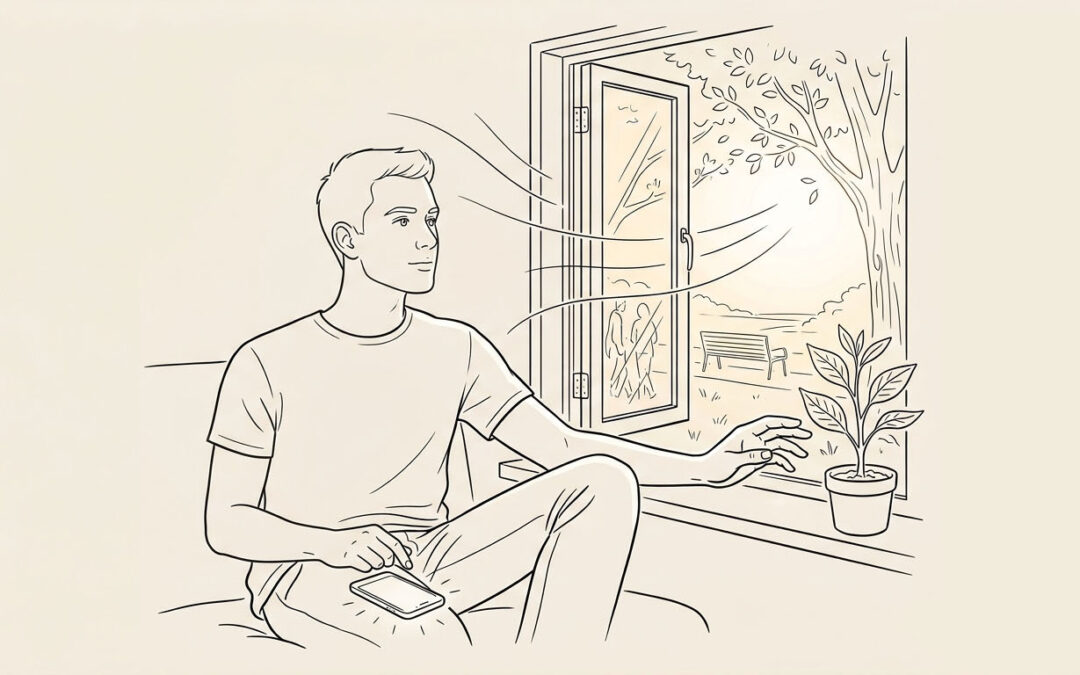
Think about the last hour you spent on your phone. Really think about it. Where did you start? Where did you end up? And here's the harder question: did you choose to go there, or were you led?
If you're honest with yourself, you probably weren't fully in control. And that's not a personal failing — it's by design.
This post is about the invisible force shaping what you believe about yourself, about women, about what it means to be a man. It's about an algorithm that has learned, with remarkable precision, how to find your insecurities and feed them. Not because it's evil. Because it's profitable.
Once you see how it works, you can't unsee it. And once you can't unsee it, you get to choose what to do about it.
You are not the Customer. You are the Product
Let's start with something most platforms don't want you to think about too carefully: your feed is not neutral.
You might believe that what you see online reflects your genuine interests — that the algorithm is a kind of mirror, showing you yourself. In reality, it's something closer to a slot machine, engineered by some of the smartest people on earth to do one thing above all others: keep you scrolling.
Platforms make money by selling your attention to advertisers. The longer you're on the platform, the more ads you see. The more ads you see, the more money they make. So every design choice — every notification, every autoplay, every "recommended for you" — is optimized for one goal. Not your growth. Not your wellbeing. Engagement.
And what generates the most engagement? Not calm, balanced, nuanced content. The content that performs best is the content that makes you feel something intense.
Anger keeps you scrolling, looking for the next thing to be outraged about. Anxiety keeps you refreshing, checking for threats. Inadequacy keeps you consuming, searching for the fix that will finally make you enough.
The algorithm has discovered this and built around it. As I discuss in Built Different: "The version of you that's most profitable is the
version that's anxious, angry, and endlessly scrolling." You are not being served. You are being harvested.
The Gradient: How Ordinary Curiosity Becomes Something Darker
Here's what I want you to understand: nobody chooses to adopt extreme views overnight. The journey is gradual, and it's engineered to feel like discovery.
It usually starts somewhere completely reasonable. You're a young guy trying to figure things out. Dating feels confusing. You're not sure where you fit. You want to feel more confident. So you do what anyone would do — you search for answers.
"How do I talk to girls."
"Why am I so lonely."
"How do I be more confident."
The first content you find is often harmless. Basic social skills, self-improvement tips, reasonably balanced perspectives. You watch it. Maybe it helps a little. The algorithm notes your interest and starts recommending more.
But here's the shift: the algorithm doesn't just serve you similar content. It serves you content that performs well. And what performs well isn't always the measured, honest advice. It's the version that's more provocative. More certain. More extreme.
"Just be confident" doesn't keep people watching as long as "here's why women are wired to respond to dominance."
You click on one. It's a little edgy, but it has a point — or seems to. You're not radicalized. You're just exploring. The algorithm notices the click and serves you more. Each recommendation is slightly more intense than the last, but the increments are small enough that you don't notice you're being walked somewhere.
Weeks pass. Months. Somewhere along the way, the content has shifted from "self-improvement" to "modern men are weak and feminized." From "understand dating" to "women are strategic and you need to be more strategic back." From "be confident" to "vulnerability is for losers and real men don't need anyone."
I call this 'the radicalization gradient' — a pathway so gently sloped that you don't realize you're descending until you look back at where you started.
Consider Tyler, whose story is in the book: a nineteen-year-old in a new city, working a warehouse job, a little lonely, who started watching fitness content in the evenings. Four months later, his feed was unrecognizable — hours a day of content telling him he was surrounded by weak men and manipulative women, that the system was rigged against him, that he needed to harden himself to survive. He felt, for the first time, like he had answers. Like he could see things other people couldn't.
He was also, by his own account two years later, the loneliest he had ever been.
The content had given him a framework. It had not given him connection. And the framework made genuine connection — with women, with most men — feel like compromise or defeat.
The Insecurity Pipeline: What the Manosphere is Really Selling
There's a loose network of online spaces — channels, forums, Discord servers, comment sections — that collectively get called the "manosphere." It spans a wide range, from relatively mild self-improvement communities to deeply toxic ideologies. But most of it shares a common sales pitch:
Your struggles are not your fault. Women are the problem. Society is rigged against you. The mainstream won't tell you this — but we will. Welcome to the brotherhood.
It works because it starts with something true. Dating is genuinely hard. Loneliness among young men is real. Economic uncertainty is real. These are legitimate problems deserving honest answers.
The manosphere offers answers. The problem is that the answers are almost always wrong, and following them makes every one of those real problems worse.
Told your loneliness is because you're not "alpha" enough? Become more dominant and emotionally closed off. Which guarantees deeper loneliness.
Told dating is a strategic game to be won through psychological manipulation? You'll never build anything meaningful with anyone. There will be no second dates.
Told vulnerability is weakness and real men don't need anyone? You'll spend the rest of your life alone inside your own head, convinced that's strength.
In my work, I've encountered young men who have followed these pathways. They arrived in my office having "won" by the manosphere's rules — the posture, the mindset, the language — and feeling hollowed out. Because what they actually wanted was connection. And they'd been sold a worldview that made connection impossible.
Why This Matters for How You Treat People
This isn't just about your wellbeing (though it is a little about that). It's about what these pathways do to the way you see and treat other people — particularly women and anyone who doesn't fit the rigid hierarchies the algorithm loves to serve.
Content that consistently frames women as adversaries to be strategically managed does not prepare you for a relationship. It poisons the ground before you even plant anything.
Content that divides the world into alphas and everyone else doesn't build your confidence. It turns every interaction into a competition and every man into a potential threat or a potential subordinate.
Content designed to generate contempt — for "betas," for "normies," for people who don't share the ideology — corrodes your capacity for empathy over time. And empathy is not soft. Empathy is the foundation of every meaningful human relationship you will ever have.
Here's a question worth sitting with: Would you want the person you're dating to know exactly what content you've been consuming? Would you be comfortable explaining to someone whose opinion matters to you why you find it valuable?
I call this the "offline litmus test," and it's one of the most useful diagnostic tools I've encountered. If there's a gap between what you consume in private and what you'd be willing to own publicly — that gap is information for you. It means the content is shaping you in ways you wouldn't consciously choose.
The Digital Short-Circuit: A Harder Conversation
There's another part of this that doesn't get talked about enough — not in a moralistic way, but in a structural way. And I want to raise it here because I think it matters for your relationships, current or future.
The same reward system that keeps you scrolling has been applied, with even more precision, to pornography. And the effects on young men's capacity for real intimacy are significant enough that any honest conversation about healthy relationships has to include it.
Your brain's reward system evolved to drive you toward things worth pursuing: connection, attraction, intimacy. Those things require effort, patience, and vulnerability. The neurochemical payoff is real — but you have to work for it.
Digital pornography delivers that payoff without the work. Unlimited novelty, unlimited scenarios, zero effort, zero risk, zero actual connection required. Your brain doesn't know the difference between pixels and people. The reward pathway fires the same way.
The problem is what happens over time when you consistently bypass the actual process:
The threshold for real-world attraction shifts. Real people, with their ordinary complexity and imperfection, struggle to compete with content engineered for maximum stimulation.
The capacity for delayed gratification weakens. Real intimacy requires patience — getting to know someone, building trust, navigating awkwardness. The short-circuit trains you that desire should be immediately satisfied.
The motivation to pursue actual connection drops. Why deal with the complexity and risk of real relationships when you can get the neurochemical hit alone in your room?
This is what I call a structural leak — not a moral failure, but an engineering problem. You're trying to build capacity for real intimacy while simultaneously training your brain that intimacy is a solo activity requiring no vulnerability.
You cannot build your future on a foundation that is leaking.
If you want to test whether this is relevant to your life, the solution is straightforward: go ninety days without. Not "cutting back." Not "just sometimes." Ninety days. If you can do that without difficulty, maybe it's genuinely not a problem. If you can't — if you start negotiating with yourself by week one, if the urge feels overwhelming, if you keep finding exceptions — then the behavior is controlling you more than you're controlling it. That's information worth having.
This is not about shame. It's about being honest with yourself about what you're creating and what you're undermining at the same time.
Taking Control: You Can Train The Algorithm Back
Here's what I find genuinely hopeful about all of this: you have more agency than the platform wants you to know.
The algorithm learns from your behavior. Every second you spend on a video, every comment, every share — it all tells the system what to serve you more of. That means you can deliberately train it differently. It's not easy, and it won't happen overnight. But it's real.
Some practical starting points:
Starve What Harms You
When you encounter rage bait, content designed to trigger inadequacy, or material that makes you more contemptuous — stop watching immediately. Don't comment, even to criticize. Don't share with mockery. Any engagement, including negative engagement, signals interest. The algorithm sees a reaction and serves you more. Give it nothing.
Feed What Builds You
Engage fully — like, comment thoughtfully, watch through to the end — with content that leaves you more capable, more curious, more connected. Skill-building tutorials. Honest discussions of complex topics. People sharing genuine experience rather than performing a persona. Creators who make you want to try something yourself.
Apply the Offline Litmus Test Regularly
Look at your watch history. Ask honestly: would I be comfortable explaining to someone I respect why I find this valuable? If yes, you're probably fine. If no, you've found something serving the algorithm's goals rather than yours. Remove it.
Set Boundaries on Access
Consider no phone for the first hour after waking. No social media after a certain time at night. The algorithm's influence over you is proportional to how much access you give it. Limit the window.
Bring In Other Inputs
Read books. Have real conversations. Spend time in physical spaces without screens. The algorithm is powerful when it's your primary source of information and social contact. It becomes one voice among many when you deliberately cultivate other inputs.
The goal isn't a perfect feed or a life without entertainment. The goal is to shift the balance — more content that builds capacity, less that extracts from you. Even a partial shift changes what you think about, what you believe, and who you're becoming.
What Real Strength Looks Like
The content pipeline described above — the manosphere, the alpha/beta hierarchy, the "red pill" community — is built on one foundational promise: that if you follow the ideology, you'll become a powerful man. Dominant. Invulnerable. Someone who doesn't need anyone.
I work with men. I have for years. And I can tell you that what those spaces actually produce is not power. It is armored loneliness — men who have convinced themselves that closing off is strength, that contempt is clarity, that needing nothing and no one is freedom.
It isn't. It's just a more sophisticated way of being afraid.
Real strength — the kind that holds up in an actual life, an actual relationship, an actual community — looks different. It looks like the ability to be honest about what you're feeling. The capacity to disagree with someone without needing to humiliate them. The willingness to be vulnerable with people who have earned that trust.
A man who knows his own value does not need to control his partner to feel powerful. Does not need to monitor her location or cut her off from her friends or tear her down to feel tall. He is secure enough to love without clutching.
The algorithm is not going to help you build that. Most of the content in the pipeline is actively working against it. But you can choose to build it anyway — deliberately, incrementally, one decision at a time about what you consume and what you refuse.
A Word About Reaching Out
If you've read this far and something has landed — a recognition, a discomfort, something you want to think through more carefully — please don't sit with it alone.
That's what the algorithm wants. Isolation is the conditions it thrives in. The moment you bring something into a real conversation with a real person whose opinion you respect, the algorithm loses its grip on it.
Talking to a counsellor, a mentor, or a trusted friend about what you've been consuming and how it's affecting you is not weakness. It is one of the most direct ways to take your thinking back.
You don't need to have it all figured out before you start that conversation. You just have to be willing to start it.
Resources and Support
If you want to examine your own feed with fresh eyes, start with an honest audit: What am I actually watching? How does it make me feel — during, and after? Would I be comfortable with someone I respect seeing my watch history? What would I have to change to build a feed that serves who I'm trying to become?
If you want to talk to someone about what you're navigating — relationship patterns, the content you've been consuming, questions about your own behavior — reach out to:
• A school or campus counsellor
• A youth mental health service in your region
• A therapist who works with young men and relationship health
• A trusted adult — teacher, coach, mentor, family member
The conversations that matter most are the ones that happen off-screen.
This post is intended for reflection and is not a substitute for professional support. If you are in immediate distress, please contact emergency services or a crisis line in your region.