
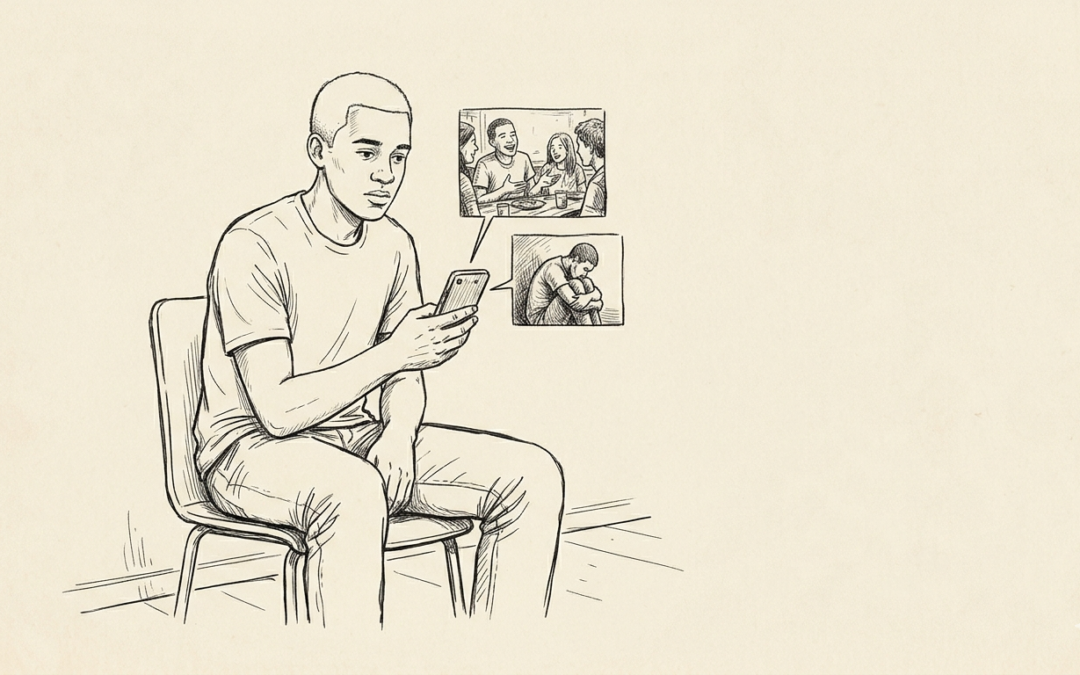
Picture this: you're at dinner with your family. Your mom asks how you've been spending your time. You mention the gym, some work stuff, a show you've been watching.
Then there's a pause.
Because you're not going to mention the three hours you spent last Tuesday watching videos about why women are fundamentally untrustworthy. You're not going to bring up the content telling you that empathy is a weakness designed to keep men down. You're not going to describe the community where everyone competes to be the most contemptuous version of themselves.
You just… skip that part.
That skip? That's the litmus test working. And it's worth paying attention to.
What Is the Offline Litmus Test?
The test is simple: If you wouldn't say it out loud to someone you respect, you probably shouldn't be consuming it.
Not because you need to perform virtue for others. Not because other people's opinions should run your life. But because the gap between what you'd admit publicly and what you're feeding your mind privately is a diagnostic signal — and most of us have learned to ignore it.
Here's the version worth memorizing: Would I be comfortable explaining to my mom, my mentor, my closest friend, or a person I genuinely admire — why I find this content valuable?
If the answer is no — if you'd have to minimize it, justify it, or hide it entirely — that discomfort is data.
Why Discomfort Matters
We tend to treat embarrassment as a social problem. Something to manage. Something to avoid by being more careful about what we say in front of whom.
But embarrassment is also a moral compass. It fires when there's a mismatch between your actions and your actual values — when the person you're presenting to the world doesn't match the person you're quietly becoming.
When you imagine explaining your content diet to someone whose judgment you trust, the rationalizations that work fine in private suddenly feel thin. I was just curious. It's not like I believe it. I watch it ironically. Against a real person with real standards, those explanations tend to collapse.
That collapse is useful. It means some part of you already knows the content isn't serving you.
The question is whether you're paying attention.
The Gradient You Don't Notice
Nobody sits down one day and decides to spend hours consuming content that makes them contemptuous, isolated, and angry. It happens incrementally.
You start with something legitimate. You're lonely, or frustrated, or uncertain about your future. You search for answers. The early content is reasonable enough — self-improvement basics, some practical advice, perspectives on navigating a confusing world.
Then the algorithm does what algorithms do. It serves you something slightly more extreme, because extreme generates engagement. You watch it. It serves you something slightly more extreme than that. Each step feels like a small discovery, a hidden truth others are too polite to say out loud.
Three months later, you're somewhere you never consciously chose to go — and the content you're consuming would make the version of you from six months ago uncomfortable.
The offline litmus test interrupts this gradient. When you pause and ask would I say this out loud to someone I respect?, you're introducing an outside perspective into a process that has been entirely private. You're forcing yourself to see what you've been consuming through the eyes of someone who isn't inside the feed with you.
That outside view is clarifying in a way that internal rationalization never can be.
How to Actually Apply It
Step one: Pick a person.
Identify one real person in your life whose respect matters to you — not because they're perfect, but because they're someone you'd genuinely be glad to make proud. A parent. A mentor. A close friend with good judgment. An older version of yourself who's built the life you want.
This person doesn't need to share all your interests or politics. They just need to be someone whose opinion you'd feel.
Step two: Audit your recent consumption.
Go through your watch history, your saved content, the accounts you follow, the communities you lurk in. For each one, run the test: Would I explain this to [person] and feel okay about it?
Not "would they agree with it." Not "would they find it interesting." Would you be comfortable — not defensive, not minimizing — explaining why this content is part of your regular diet?
Step three: Pay attention to your reaction.
The content that makes you immediately defensive is usually the content worth examining most carefully. Notice the urge to explain it away. It's not that bad. You'd have to understand the context. It's more nuanced than it sounds.
Those rationalizations are often the content's influence already at work.
Step four: Ask what the gap is telling you.
If there's consistent content you'd hide from the people who know you best, that gap is meaningful. It might mean the content conflicts with values you actually hold. It might mean the content is shaping you in ways you wouldn't consciously choose. It might mean you already know, at some level, that this isn't good for you.
The discomfort isn't a verdict. It's an invitation to look more carefully.
What the Test Catches
The offline litmus test is particularly good at identifying a few specific categories of content that tend to do quiet damage:
Content that treats people as categories, not humans. If you're regularly consuming material that reduces entire groups — women, men, people of different backgrounds — to flat, contemptible types, ask whether you'd voice those characterizations to someone you respect. Usually you wouldn't, because you already know, at some level, that they're not true — and that believing them makes you worse at the thing you actually want, which is genuine connection.
Content that makes you feel superior without making you more capable. There's a particular kind of content that flatters you — tells you that you can see what others can't, that you're awake while everyone else is asleep, that you're above the naive masses. It feels like wisdom. Ask if you'd explain it to someone you genuinely admire. If the explanation sounds like "I know things other people are too weak to handle," you're probably just consuming flattery, not insight.
Content that you return to but feel worse after. Some content creates a loop: you watch it, you feel temporarily satisfied or vindicated, and then you feel a little emptier. You go back because the short-term hit is real, even though the longer-term effect is corrosive. The offline test catches this because the reason you keep going back isn't something you'd want to explain out loud.
Content that's making you angrier without making you more effective. Outrage is the most powerful engagement mechanism platforms have found. If your content diet is consistently generating rage — at people, at systems, at groups — ask whether the anger is producing anything useful. Would you tell someone you respect: "I spend a lot of time being angry about this"? If not, worth asking what the anger is actually for.
A Note on What the Test Isn't
The offline litmus test is not a call to be seen only consuming "respectable" content. It's not about performing virtue. It's not about caring what strangers think.
You're allowed to watch stupid, lowbrow, not-particularly-uplifting content. Entertainment is real. Humor is real. Curiosity about dark or difficult topics is real. None of that fails the test automatically.
The test is specifically about the gap between your public and private self. It's about content that you hide — not because it's private in a healthy sense, but because some part of you recognizes that it conflicts with who you want to be.
The goal isn't a feed where everything is serious and instructive. The goal is a feed you could own — that you'd be comfortable acknowledging as part of how you spend your mind.
The Harder Question
Here's what the test is really asking, underneath all of it:
Is what you're consuming making you into someone you'd be proud to be?
Not someone impressive. Not someone who wins arguments online. Not someone with the right opinions or the sharpest takes. Just — someone you'd look back on and recognize as someone worth being.
Your attention isn't just time. It's the raw material from which you build your character. What you expose yourself to consistently becomes part of how you think, what you believe, what you're capable of feeling. That's not metaphorical. It's how minds actually work.
If you're feeding yours with content you'd be embarrassed to acknowledge — content that makes you more contemptuous, more isolated, more certain that the world is arranged against you — you're not just wasting time.
You're building something you might not want to be living inside of.
The litmus test is simple. It costs nothing. It takes thirty seconds.
Next time you're about to scroll into familiar territory, just ask: Would I say this out loud to someone I respect?
If the answer is no, you already know what to do with that.